Skip to main content
Microbiology
My Course
Learn
Exam Prep
AI Tutor
Study Guides
Textbook Solutions
Flashcards
Explore
Try the app
My Course
Learn
Exam Prep
AI Tutor
Study Guides
Textbook Solutions
Flashcards
Explore
Try the app
Back
Introduction to Staining quiz #1
You can tap to flip the card.
What is the purpose of staining in microbiology?
You can tap to flip the card.
👆
What is the purpose of staining in microbiology?
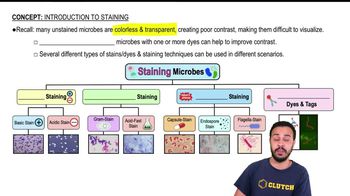
Staining improves contrast, making colorless and transparent microbes easier to visualize under a microscope.
Track progress
Control buttons has been changed to "navigation" mode.
1/20
Related flashcards
Related practice
Recommended videos
Introduction to Staining definitions
Introduction to Staining
15 Terms
Introduction to Staining
9. Microscopes
Topic
Simple Staining
9. Microscopes
4 problems
Topic
Monica
9. Microscopes - Part 1 of 3
6 topics
12 problems
Chapter
Nicole
9. Microscopes - Part 2 of 3
8 topics
10 problems
Chapter
Nicole
9. Microscopes - Part 3 of 3
1 topic
3 problems
Chapter
02:10
Introduction to Staining
3128
views
49
rank
Terms in this set (20)
Hide definitions
What is the purpose of staining in microbiology?
Staining improves contrast, making colorless and transparent microbes easier to visualize under a microscope.
Why is heat fixing a sample important in microscopy?
Heat fixing attaches the specimen to the slide and preserves its structure for staining and observation.
Staining is an important way to improve which aspect of microscopy?
Staining improves contrast, allowing for clearer visualization of microbes.
What is the purpose of using a biological stain when examining cellular components microscopically?
Biological stains enhance contrast, making cellular components more visible under the microscope.
Why would a scientist stain a specimen before observing it with a compound light microscope?
Staining increases contrast, making transparent specimens easier to see and study.
What is the staining method called where the dye sticks to the specimen and gives it color?
This is called simple staining, where the dye binds directly to the specimen.
Which term describes a thin slice of tissue mounted on a microscope slide?
A section describes a thin slice of tissue mounted on a slide.
Why are bacterial smears fixed before staining?
Fixing attaches bacteria to the slide and preserves their structure for staining.
What are some consequences of leaving a stain on a bacterial smear too long?
Overstaining can obscure details and make it difficult to distinguish cellular structures.
How do chemical stains make light microscopes more useful?
Chemical stains increase contrast, allowing for better visualization of transparent microbes.
Staining makes cells more visible by increasing what?
Staining increases contrast between cells and their background.
What is enhanced when a stain is used to make a sample?
Contrast is enhanced, making the sample easier to observe.
Why is a wet-mount slide preparation of a specimen stained?
Staining a wet-mount increases contrast, making the specimen more visible.
A procedure that requires the use of a single dye to stain a specimen is called what type of staining?
This is called simple staining.
Dyes are often used during microscopy to increase which property?
Dyes increase contrast between the specimen and the background.
The purpose of staining cells on a microscope slide is to ______.
The purpose is to increase contrast and make cells more visible.
Staining cells so their color differs from the background enhances their what?
It enhances their visibility and contrast.
In a negative stain, which part is stained?
In a negative stain, the background is stained, not the specimen.
What is the purpose of staining cells on a microscope slide?
Staining increases contrast, making cells easier to observe.
Match the staining technique to the appropriate example: Simple stain, Differential stain, Special stain.
Simple stain: uses one dye; Differential stain: Gram stain or acid-fast stain; Special stain: capsule, endospore, or flagella stain.
 BackBack
 02:10
02:10