Skip to main content
Microbiology
My Course
Learn
Exam Prep
AI Tutor
Study Guides
Textbook Solutions
Flashcards
Explore
Try the app
My Course
Learn
Exam Prep
AI Tutor
Study Guides
Textbook Solutions
Flashcards
Explore
Try the app
Back
Isotopes definitions
You can tap to flip the card.
Isotope
You can tap to flip the card.
👆
Isotope
Atom of the same element with a different number of neutrons, resulting in a distinct mass number.
Track progress
Control buttons has been changed to "navigation" mode.
1/15
Related flashcards
Related practice
Recommended videos
Isotopes quiz
Isotopes
15 Terms
Isotopes
3. Chemical Principles of Microbiology
4 problems
Topic
Brendan
Introduction to Chemical Bonding
3. Chemical Principles of Microbiology
6 problems
Topic
Brendan
3. Chemical Principles of Microbiology
7 topics
12 problems
Chapter
Nicole
06:50
Isotopes
30272
views
590
rank
02:37
Radioactive Isotopes
20971
views
362
rank
Terms in this set (15)
Hide definitions
Isotope
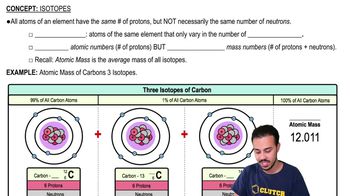
Atom of the same element with a different number of neutrons, resulting in a distinct mass number.
Neutron
Neutral subatomic particle found in the nucleus, responsible for differences among isotopes of an element.
Proton
Positively charged subatomic particle in the nucleus; its count defines the element's identity.
Electron
Negatively charged subatomic particle orbiting the nucleus; its number matches protons in a neutral atom.
Atomic Number
Value representing the number of protons in an atom, uniquely identifying the element.
Mass Number
Sum of protons and neutrons in an atom's nucleus, distinguishing different isotopes.
Atomic Mass
Weighted average of all isotopes' masses for an element, reflecting their natural abundance.
Carbon-12
Most common carbon isotope, containing 6 protons and 6 neutrons, making up about 99% of carbon atoms.
Carbon-13
Stable carbon isotope with 6 protons and 7 neutrons, less abundant than the most common form.
Carbon-14
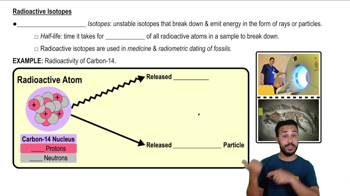
Radioactive carbon isotope with 6 protons and 8 neutrons, used in dating ancient biological materials.
Radioactive Isotope
Unstable atom variant that decays over time, emitting energy and particles from its nucleus.
Half-life
Time required for half the atoms in a radioactive sample to decay, used to estimate ages of materials.
Radiometric Dating
Technique using radioactive isotopes and their half-lives to determine the age of fossils or rocks.
Abundance
Proportion of a specific isotope present among all atoms of an element in nature.
Nucleus
Central region of an atom containing protons and neutrons, where mass and isotopic differences arise.
 BackBack
 06:50
06:50