Skip to main content
Microbiology
My Course
Learn
Exam Prep
AI Tutor
Study Guides
Textbook Solutions
Flashcards
Explore
Try the app
My Course
Learn
Exam Prep
AI Tutor
Study Guides
Textbook Solutions
Flashcards
Explore
Try the app
Back
John Tyndall's Experiment definitions
You can tap to flip the card.
John Tyndall
You can tap to flip the card.
👆
John Tyndall
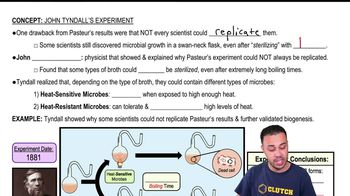
A 19th-century physicist who explained why some sterilization attempts failed, clarifying the existence of heat resistant microbes.
Track progress
Control buttons has been changed to "navigation" mode.
1/13
Related flashcards
Related practice
Recommended videos
John Tyndall's Experiment quiz #1
John Tyndall's Experiment
10 Terms
John Tyndall's Experiment
2. Disproving Spontaneous Generation
3 problems
Topic
Nicole
History of Spontaneous Generation Summarized
2. Disproving Spontaneous Generation
3 problems
Topic
Nicole
2. Disproving Spontaneous Generation
6 topics
11 problems
Chapter
Brendan
05:48
John Tyndall's Experiment
2595
views
34
rank
Terms in this set (13)
Hide definitions
John Tyndall
A 19th-century physicist who explained why some sterilization attempts failed, clarifying the existence of heat resistant microbes.
Louis Pasteur
A scientist whose swan neck flask experiment supported biogenesis, but whose results were sometimes difficult to replicate.
Swan Neck Flask
A curved glass vessel used to prevent airborne contamination while allowing air exchange during microbial experiments.
Sterilization
A process intended to eliminate all forms of microbial life, though effectiveness depends on the types of microbes present.
Heat Sensitive Microbes
Microorganisms that are destroyed by exposure to high temperatures, enabling successful sterilization by boiling.
Heat Resistant Microbes
Microorganisms capable of surviving high temperatures, often causing failed sterilization attempts.
Broth
A nutrient-rich liquid medium used to culture microbes, which may contain either heat sensitive or heat resistant forms.
Endospores
Highly durable, dormant bacterial structures that withstand extreme heat and are responsible for persistent contamination.
Biogenesis
The principle that living organisms arise only from pre-existing life, further validated by Tyndall's findings.
Contaminant
An unwanted microorganism present in a culture, often responsible for unexpected microbial growth after sterilization.
Boiling
A common heat-based method for attempting sterilization, effective only against heat sensitive microbes.
Replication
The process of repeating an experiment to verify results, which was problematic in Pasteur's case due to microbial variability.
Sterilization Technique
A specific method or procedure used to eliminate all microbes, which must be tailored to the types present in the sample.
 BackBack
 05:48
05:48