What was John Tyndall's contribution to the field of microbiology?
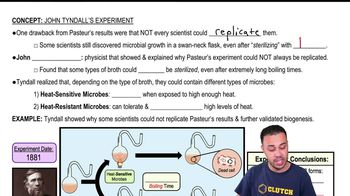
John Tyndall demonstrated that some microbes are heat resistant and can survive boiling, explaining why some scientists could not replicate Pasteur's sterilization results. He categorized microbes into heat sensitive and heat resistant groups, showing that different sterilization techniques are needed for different types of microbes. His work supported Pasteur's findings and further validated the concept of biogenesis.
Why did some scientists observe microbial growth in swan neck flasks after heat sterilization?
Some scientists used broths containing heat resistant microbes, which survived boiling and led to microbial growth despite attempts at sterilization.
How did John Tyndall categorize microbes in his experiment?
He divided microbes into heat sensitive, which die at high temperatures, and heat resistant, which survive boiling.
What did John Tyndall discover about the effectiveness of boiling for sterilization?
He found that boiling was only effective against heat sensitive microbes, but not against heat resistant ones.
What role do endospores play in heat resistance among microbes?
Endospores are a form of heat resistant microbes that can survive high temperatures and are difficult to kill by boiling.
How did the type of broth affect the outcome of sterilization in Tyndall's experiment?
Broths containing heat resistant microbes could not be sterilized by boiling, while those with only heat sensitive microbes could.
What implication did Tyndall's findings have for laboratory sterilization techniques?
His findings showed that different sterilization methods are needed depending on whether heat resistant microbes are present.
How did Tyndall's experiment help validate the concept of biogenesis?
By explaining why some flasks showed growth after boiling, Tyndall supported Pasteur's idea that life arises from existing life, not spontaneously.
What year did John Tyndall conduct his experiment that clarified issues with Pasteur's results?
John Tyndall conducted his experiment in 1881.
Who later discovered the specific heat resistant forms called endospores mentioned in Tyndall's work?
Ferdinand Cohn later discovered endospores, which are heat resistant forms of some bacteria.