Where do the light-dependent reactions of photosynthesis take place within plant cells?
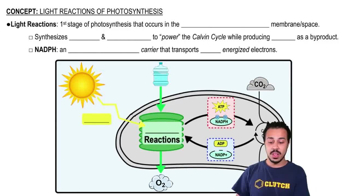
The light-dependent reactions of photosynthesis take place in the thylakoid membranes of chloroplasts.
What are the main products of the light reactions of photosynthesis?
The main products are ATP, NADPH, and oxygen gas (O2).
Which molecule serves as the final electron acceptor in the light reactions?
NADP+ serves as the final electron acceptor and is reduced to NADPH.
What is the role of water in the light reactions of photosynthesis?
Water is split to provide electrons for the process and produces oxygen gas as a byproduct.
How is ATP generated during the light reactions?
ATP is generated by chemiosmosis, using the proton gradient created across the thylakoid membrane.
What is the function of photosystem II in the light reactions?
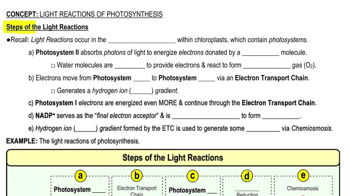
Photosystem II absorbs photons and energizes electrons from water molecules.
What happens to the oxygen produced during the light reactions?
Oxygen can be used by the plant for cellular respiration or released into the atmosphere through stomata.
What is the purpose of the electron transport chain in the light reactions?
The electron transport chain transfers electrons between photosystems and helps create a proton gradient.
How does photosystem I contribute to the light reactions?
Photosystem I re-energizes electrons with photons before they are transferred to NADP+.
What mnemonic story is used to help remember the sequence of the light reactions?
A story about Luke and Ryan playing PlayStation 2 and 1, losing controllers, and studying chemistry helps recall the order: PS2, ETC, PS1, NADP+ reduction, and chemiosmosis.
 Back
Back
 01:48
01:48