Skip to main content
Microbiology
My Course
Learn
Exam Prep
AI Tutor
Study Guides
Textbook Solutions
Flashcards
Explore
Try the app
My Course
Learn
Exam Prep
AI Tutor
Study Guides
Textbook Solutions
Flashcards
Explore
Try the app
Back
Meselson-Stahl Experiment definitions
You can tap to flip the card.
Meselson-Stahl Experiment
You can tap to flip the card.
👆
Meselson-Stahl Experiment
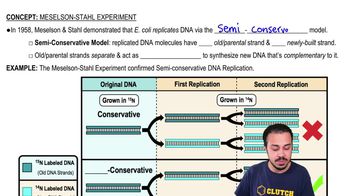
A landmark study using isotopic labeling to confirm the semi-conservative mechanism of DNA replication in E. coli.
Track progress
Control buttons has been changed to "navigation" mode.
1/15
Related flashcards
Related practice
Recommended videos
Meselson-Stahl Experiment quiz
Meselson-Stahl Experiment
15 Terms
Meselson-Stahl Experiment
14. DNA Replication
3 problems
Topic
Brendan
Introduction to DNA Replication
14. DNA Replication
3 problems
Topic
Brendan
14. DNA Replication
10 topics
14 problems
Chapter
Brendan
09:03
Meselson-Stahl Experiment
12027
views
128
rank
Terms in this set (15)
Hide definitions
Meselson-Stahl Experiment
A landmark study using isotopic labeling to confirm the semi-conservative mechanism of DNA replication in E. coli.
Semi-conservative Model
A replication process where each DNA molecule contains one parental strand and one newly synthesized strand.
Conservative Model
A disproven hypothesis suggesting the original DNA molecule remains intact while an entirely new copy is made.
Dispersive Model
A rejected theory proposing that parental DNA is interspersed in segments throughout both strands of daughter molecules.
DNA Replication
The cellular process ensuring genetic information is accurately copied for transmission to new cells.
E. coli
A bacterial species used as a model organism to study DNA replication mechanisms in the experiment.
Nitrogen-15
A heavy isotope used to label original DNA strands, allowing differentiation from newly synthesized DNA.
Nitrogen-14
A lighter isotope incorporated into new DNA strands, enabling tracking of replication events.
Parental Strand
An original DNA strand serving as a template for the synthesis of a complementary new strand.
Template
A DNA strand guiding the assembly of a complementary sequence during replication.
Isotopic Labeling
A technique using different atomic forms to distinguish between old and new DNA strands.
Generation
A single cycle of cell division, marking the passage of genetic material to progeny.
Strand Separation
The process where two DNA strands dissociate, allowing each to guide synthesis of a new partner.
Model Organism
A species extensively studied to understand biological processes, such as E. coli in DNA research.
Replication Mechanism
The specific sequence of molecular events by which DNA is duplicated within a cell.
 BackBack
 09:03
09:03