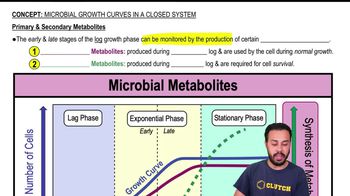
Which of the following characterizes the lag phase of a normal bacterial growth curve?
The lag phase is characterized by cells adjusting to their new environment and synthesizing enzymes required for growth, with little to no increase in cell number.
Which category of diagnosis is represented by studying a microbe’s utilization of nutrients?
Studying a microbe’s utilization of nutrients falls under metabolic or biochemical diagnosis, as it involves analyzing metabolic activities such as nutrient uptake and metabolite production.
Which graph best represents the general rate at which bacteria reproduce in a closed system?
A graph with a logarithmic Y-axis (number of cells) and a time-based X-axis, showing four phases: lag, exponential (log), stationary, and decline, best represents bacterial reproduction in a closed system.
The growth of bacterial cultures in a closed system is best described as occurring in four distinct phases: lag, log (exponential), stationary, and decline (death).
Bacterial growth in a closed system follows four phases: lag (adjustment), log (exponential growth), stationary (growth equals death rate), and decline (increased cell death).
What are the typical growth patterns observed in broth cultures during the different phases of the bacterial growth curve?
In broth cultures: lag phase shows little turbidity, log phase shows increasing turbidity, stationary phase shows maximum turbidity, and decline phase shows decreasing turbidity as cells die.
The log phase of a normal growth curve is also referred to as the exponential phase.
True. The log phase is also called the exponential phase, where cells divide and grow at a continuous, rapid rate.
Which of the growth curves represents an obligate anaerobe grown in the presence of oxygen?
An obligate anaerobe grown in the presence of oxygen would show a rapid decline or no significant growth, as oxygen is toxic to these organisms.
During which phase of growth are bacteria most susceptible to antibiotics?
Bacteria are most susceptible to antibiotics during the log (exponential) phase, when they are actively dividing.
The log phase of a normal growth curve is also referred to as the growth phase.
True. The log phase is the active growth phase where cells divide rapidly.
How many generations does it take for a single bacterial cell to become 256 cells?
It takes 8 generations for a single bacterial cell to become 256 cells (since 2^8 = 256).
Identify the phases of a bacterial growth curve. Not all labels are used.
The phases of a bacterial growth curve are: lag phase, log (exponential) phase, stationary phase, and decline (death) phase.