Skip to main content
Microbiology
My Course
Learn
Exam Prep
AI Tutor
Study Guides
Textbook Solutions
Flashcards
Explore
Try the app
My Course
Learn
Exam Prep
AI Tutor
Study Guides
Textbook Solutions
Flashcards
Explore
Try the app
Back
Nucleic Acids definitions
You can tap to flip the card.
Nucleic Acid
You can tap to flip the card.
👆
Nucleic Acid
A biomolecule polymer responsible for storing and encoding genetic information, composed of nucleotide monomers.
Track progress
Control buttons has been changed to "navigation" mode.
1/15
Related flashcards
Related practice
Recommended videos
Nucleic Acids quiz
Nucleic Acids
15 Terms
Nucleic Acids
5. Molecules of Microbiology
7 problems
Topic
Nicole
Lipids
5. Molecules of Microbiology
4 problems
Topic
Nicole
5. Molecules of Microbiology
8 topics
14 problems
Chapter
Nicole
01:05
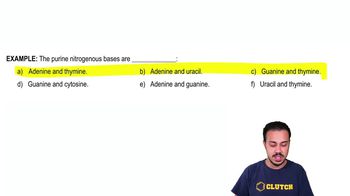
Nucleic Acids Example 2
16869
views
173
rank
04:07
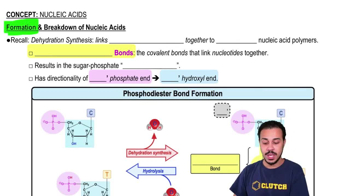
Formation & Breakdown of Nucleic Acids
19168
views
248
rank
05:57
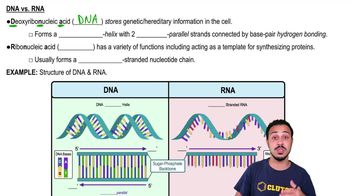
DNA vs. RNA
19299
views
233
rank
Terms in this set (15)
Hide definitions
Nucleic Acid
A biomolecule polymer responsible for storing and encoding genetic information, composed of nucleotide monomers.
Nucleotide
A monomer unit made of a phosphate group, a pentose sugar, and a nitrogenous base, forming nucleic acid chains.
Phosphate Group
A functional group containing phosphorus, forming part of the nucleotide structure and the nucleic acid backbone.
Pentose Sugar
A five-membered ring sugar found in nucleotides; deoxyribose in DNA and ribose in RNA.
Nitrogenous Base
A molecule rich in nitrogen atoms, classified as purine or pyrimidine, providing genetic code specificity.
Phosphodiester Bond
A covalent linkage joining nucleotides in a nucleic acid, forming the sugar-phosphate backbone.
Sugar-Phosphate Backbone
A repeating chain of sugars and phosphates, providing structural support and directionality to nucleic acids.
Directionality
The orientation of nucleic acid strands, defined by chemically distinct 5' and 3' ends.
Deoxyribose
A pentose sugar lacking one oxygen atom, found in DNA nucleotides.
Ribose
A pentose sugar with a hydroxyl group, present in RNA nucleotides.
Purine
A double-ring nitrogenous base; includes adenine and guanine, pairing with pyrimidines in nucleic acids.
Pyrimidine
A single-ring nitrogenous base; includes cytosine, thymine, and uracil, pairing with purines.
Double Helix
A twisted ladder-like structure formed by two antiparallel DNA strands connected by base pairs.
Antiparallel Strands
Two nucleic acid chains running in opposite 5' to 3' directions, essential for DNA structure.
Hydrogen Bond
A weak interaction stabilizing DNA structure by connecting complementary nitrogenous bases across strands.
 BackBack
 01:05
01:05