Skip to main content
Microbiology
My Course
Learn
Exam Prep
AI Tutor
Study Guides
Textbook Solutions
Flashcards
Explore
Try the app
My Course
Learn
Exam Prep
AI Tutor
Study Guides
Textbook Solutions
Flashcards
Explore
Try the app
Back
Osmosis definitions
You can tap to flip the card.
Osmosis
You can tap to flip the card.
👆
Osmosis
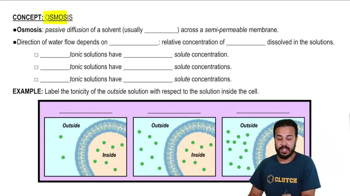
Passive movement of water across a semipermeable membrane, driven by solute concentration differences, without energy input.
Track progress
Control buttons has been changed to "navigation" mode.
1/15
Related flashcards
Related practice
Recommended videos
Osmosis quiz #1
Osmosis
10 Terms
Osmosis
6. Cell Membrane & Transport
4 problems
Topic
Nicole
Simple and Facilitated Diffusion
6. Cell Membrane & Transport
5 problems
Topic
Brendan
6. Cell Membrane & Transport - Part 1 of 2
7 topics
12 problems
Chapter
Monica
6. Cell Membrane & Transport - Part 2 of 2
8 topics
13 problems
Chapter
Brendan
02:18
Osmosis Example 1
20652
views
349
rank
1
comments
05:59
Osmosis
26851
views
467
rank
1
comments
06:48
Direction of Osmosis
22264
views
366
rank
Terms in this set (15)
Hide definitions
Osmosis
Passive movement of water across a semipermeable membrane, driven by solute concentration differences, without energy input.
Passive Diffusion
Movement of molecules from high to low concentration without energy, as seen in water movement during osmosis.
Semipermeable Membrane
Barrier allowing selective passage of certain molecules, such as water, while blocking others like solutes.
Solvent
Substance, typically water in biology, that dissolves solutes and moves across membranes during osmosis.
Solute
Dissolved substance in a solution, whose concentration determines the direction of water movement in osmosis.
Tonicity
Relative concentration of solutes in two regions separated by a membrane, influencing water movement.
Hypotonic Solution
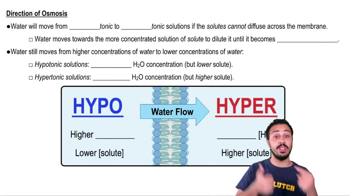
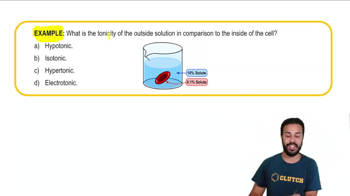
Environment with lower solute and higher water concentration compared to another region, causing cells to swell.
Isotonic Solution
Environment with equal solute concentration on both sides of a membrane, resulting in no net water movement.
Hypertonic Solution
Environment with higher solute and lower water concentration compared to another region, causing cells to shrink.
Cell Lysis
Bursting of a cell due to excessive water intake, often occurring in animal cells in hypotonic environments.
Turgor Pressure
Pressure exerted by water inside the cell membrane against the cell wall, maintaining plant cell structure.
Dehydration
Loss of water from cells, leading to shrinkage and impaired function, especially in hypertonic environments.
Cell Wall
Rigid outer layer in plant cells that prevents bursting and supports turgor pressure during water influx.
Biological Membrane
Structure composed of lipid bilayers that separates cell interior from the external environment and regulates movement.
Water Concentration
Amount of water present in a solution, inversely related to solute concentration and crucial for osmosis direction.
 BackBack
 02:18
02:18