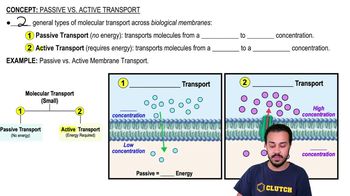
Movement of molecules from high to low concentration across membranes without energy input, driven by concentration gradients.
Active Transport
Movement of molecules from low to high concentration across membranes, requiring cellular energy, typically in the form of ATP.
Concentration Gradient
Difference in the amount of a substance across a membrane, driving passive movement from high to low regions.
ATP
High-energy molecule used by cells to power processes such as active transport against concentration gradients.
Membrane
Biological barrier that regulates the passage of molecules into and out of cells, involved in both passive and active transport.
Transport Protein
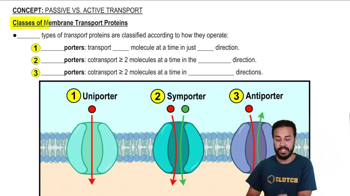
Membrane-embedded molecule that facilitates the movement of substances across the cell boundary, classified by direction and number of molecules moved.
Uniporter
Type of transport protein that moves a single molecule in one direction across the membrane.
Symporter
Transport protein that simultaneously moves two or more molecules in the same direction across the membrane.
Antiporter
Transport protein that moves two or more molecules in opposite directions across the membrane at the same time.
Energy Requirement
Cellular necessity for input, such as ATP, to drive processes like active transport against natural gradients.
Directionality
Characteristic describing whether molecules move in the same or opposite directions during transport across membranes.
Co-transport
Simultaneous movement of multiple molecules across a membrane, as seen in symporters and antiporters.
High Concentration
Region where a particular molecule is present in greater abundance, serving as the starting point for passive movement.
Low Concentration
Region where a molecule is less abundant, typically the endpoint for passive movement or starting point for active movement.
Biological Membrane
Selective barrier composed of lipids and proteins, crucial for regulating molecular traffic in cells.
 Back
Back
 03:41
03:41