Back

pH Requirements for Microbial Growth definitions

Control buttons has been changed to "navigation" mode.
1/15
  • Optimal pH

    Specific value where a microorganism's growth rate is highest, reflecting the most favorable environmental acidity or basicity for that species.
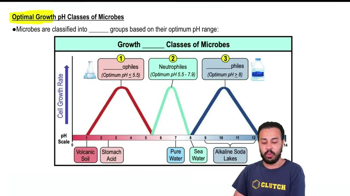
  • Acidophile

    Microbe thriving in environments with pH ≤ 5.5, often found in highly acidic habitats like volcanic soil or stomach acid.
  • Neutrophile

    Microbe with best growth at pH 5.5–7.9, favoring near-neutral environments such as pure water.
  • Alkalophile

    Microbe growing optimally at pH ≥ 8, commonly inhabiting basic environments like alkaline soda lakes.
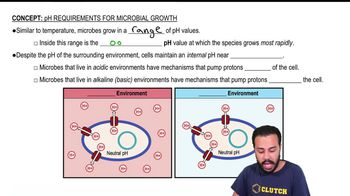
  • Internal pH

    Nearly neutral condition maintained inside microbial cells, regardless of the external environment's acidity or basicity.
  • Proton Pump

    Cellular mechanism moving hydrogen ions in or out to help maintain internal pH and adapt to external acidic or basic conditions.
  • Acidic Environment

    Surrounding with high hydrogen ion concentration, typically with pH values below 7, favoring acidophile growth.
  • Basic Environment

    Surrounding with low hydrogen ion concentration, typically with pH values above 7, supporting alkalophile growth.
  • pH Scale

    Measurement system ranging from 0 to 14, indicating the acidity or basicity of a solution, with 7 as neutral.
  • Growth Rate

    Speed at which microbial cells multiply, influenced by environmental pH and peaking at the optimal pH.
  • Hydrogen Ion

    Positively charged particle whose concentration determines the acidity or basicity of an environment.
  • Volcanic Soil

    Example of a highly acidic habitat (pH ~1) where acidophiles can thrive.
  • Stomach Acid

    Human digestive fluid with a pH around 2.5, providing an acidic environment for certain microbes.
  • Alkaline Soda Lake

    Natural habitat with pH between 9 and 12, supporting the growth of alkalophiles.
  • Pure Water

    Substance with a neutral pH of 7, serving as a typical environment for neutrophiles.