Which plating methods are commonly used for counting bacteria in a sample?
The spread plate and pour plate methods are commonly used for counting bacteria, as they involve plating diluted cultures onto solid agar and allow for the enumeration of colonies.
What is the primary purpose of the streak plate method in microbiology?
The streak plate method is primarily used to isolate individual species of microbes from a mixed culture by diluting them across the plate.
What tool is commonly used to streak microbes on an agar plate during the streak plate method?
A sterilized inoculating loop, made of metal or glass, is commonly used to streak microbes on an agar plate.
Why is it important to sterilize the inoculating loop between streaking different areas on the plate?
Sterilizing the loop between streaks prevents cross-contamination and ensures that fewer microbes are transferred to each subsequent area, aiding in isolation.
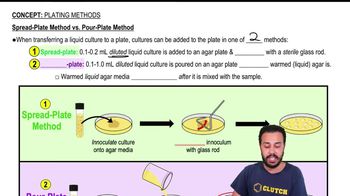
How does the spread plate method distribute microbes on the agar surface?
In the spread plate method, a diluted liquid culture is spread evenly across the agar surface using a sterile glass rod.
What is the typical volume of liquid culture used in the spread plate method?
Typically, 0.1 to 0.2 milliliters of diluted liquid culture are used in the spread plate method.
Describe the main difference in how microbes are added to the plate in the pour plate method compared to the spread plate method.
In the pour plate method, microbes are added to an empty plate first, then mixed with pre-warmed liquid agar, whereas in the spread plate method, microbes are spread directly onto solid agar.
What is the purpose of swirling the plate in the pour plate method?
Swirling the plate mixes the microbes with the liquid agar before it solidifies, ensuring even distribution throughout the medium.
Why can't the spread plate and pour plate methods be used to isolate specific species from a mixed culture?
These methods do not sufficiently dilute the microbes to separate individual species, unlike the streak plate method which allows for isolation.
What happens to the number of microbes in each area as you progress through the streak plate method?
The number of microbes decreases with each subsequent streaked area, leading to isolated colonies in the final area.