Back

Post-Translational Modification definitions

Control buttons has been changed to "navigation" mode.
1/12
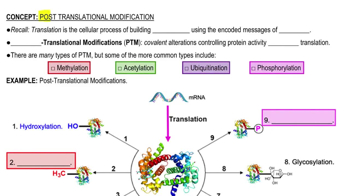
  • Post Translational Modification

    Covalent alteration of a protein after translation, crucial for regulating protein activity and function.
  • Methylation

    Addition of a methyl group (CH3) to a protein, impacting its function or interactions.
  • Acetylation

    Attachment of an acetyl group to a protein, often influencing protein stability or activity.
  • Ubiquitination

    Covalent linkage of a small protein, ubiquitin, to a target protein, often marking it for degradation.
  • Phosphorylation

    Addition of a phosphate group to a protein, commonly altering its activity or signaling role.
  • Hydroxylation

    Incorporation of a hydroxyl group into a protein, modifying its chemical properties.
  • Lipidation

    Attachment of a lipid molecule to a protein, affecting its membrane association or localization.
  • Disulfide Bond

    Covalent linkage between two sulfur atoms in proteins, stabilizing their three-dimensional structure.
  • Sulfonation

    Addition of a sulfur-containing group to a protein, influencing its function or interactions.
  • Glycosylation

    Attachment of a carbohydrate group to a protein, impacting folding, stability, or cell signaling.
  • Polypeptide Chain

    Linear sequence of amino acids formed during translation, serving as the precursor for protein modification.
  • Messenger RNA

    Molecule carrying genetic instructions from DNA, directing the synthesis of proteins during translation.