Prokaryotic Flagellar Movement quiz #1 Flashcards

Prokaryotic Flagellar Movement quiz #1
Control buttons has been changed to "navigation" mode.
1/10
  • Which of the following bacterial structures is most directly linked to chemotaxis?
    The flagellum is the bacterial structure most directly linked to chemotaxis, as it enables movement in response to chemical signals.
  • Which explanation best accounts for the differences in bacterial movement between patterns A and B?
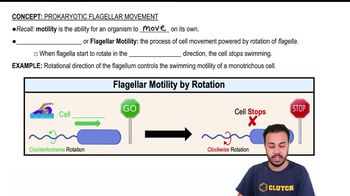
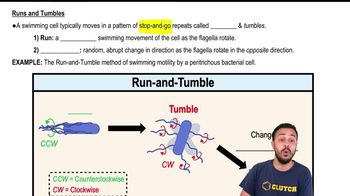
    Differences in bacterial movement patterns, such as runs and tumbles, are explained by changes in the direction of flagellar rotation; coordinated counterclockwise rotation leads to smooth runs, while clockwise rotation causes tumbles and changes in direction.
  • Bacteria use flagella to move purposefully toward or away from a chemical by which of the following mechanisms?
    Bacteria use flagella to move toward or away from chemicals by alternating between runs (smooth movement) and tumbles (directional changes) in response to chemical signals.
  • How do bacterial cells move by flagellar motion in response to chemical signals during chemotaxis?
    During chemotaxis, bacterial cells move by flagellar rotation, alternating between runs and tumbles to navigate toward attractants or away from repellents.
  • What is the difference between monotrichous and peritrichous bacterial cells regarding flagella?
    Monotrichous cells have a single flagellum at one pole, while peritrichous cells have multiple flagella distributed around the cell surface.
  • What type of energy powers the rotation of prokaryotic flagella?
    The rotation of prokaryotic flagella is powered by a proton motive force (PMF).
  • What happens to a bacterial cell's movement when its flagella switch from counterclockwise to clockwise rotation?
    When flagella switch from counterclockwise to clockwise rotation, the cell stops its smooth movement and undergoes a tumble, changing direction.
  • How does the run and tumble pattern benefit bacterial navigation?
    The run and tumble pattern allows bacteria to change direction and adapt their movement, helping them navigate toward favorable environments.
  • What is the main function of a 'run' in bacterial flagellar movement?
    A 'run' is a period of smooth, directional movement powered by coordinated flagellar rotation.
  • Why is flagellar motility also called swimming motility?
    Flagellar motility is called swimming motility because it enables bacteria to move through their environment in a manner similar to swimming.