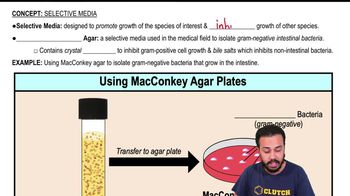
A selective medium is a type of microbial growth media designed to promote the growth of specific species of interest while inhibiting the growth of other species. For example, MacConkey agar selectively allows gram-negative intestinal bacteria to grow by inhibiting gram-positive and non-intestinal bacteria.
Can selective media also be differential? Explain.
Selective media can also be differential. For example, MacConkey agar is both selective (promoting gram-negative intestinal bacteria) and differential (distinguishing lactose fermenters from non-fermenters by color change). Thus, a medium can have both selective and differential properties.
What two components in MacConkey agar are responsible for its selective properties?
Crystal violet and bile salts are responsible; crystal violet inhibits gram-positive bacteria, and bile salts inhibit non-intestinal bacteria.
Why is MacConkey agar commonly used in medical diagnostics?
It is used because it isolates gram-negative intestinal bacteria by inhibiting other types, making it useful for identifying pathogens in clinical samples.
What happens to gram-positive bacteria when plated on MacConkey agar?
Gram-positive bacteria are inhibited by the crystal violet in the agar and do not grow or form colonies.
How does MacConkey agar help in isolating bacteria from a mixed culture?
It selectively allows only gram-negative intestinal bacteria to grow, while inhibiting others, so only those colonies appear on the plate.
What is the role of bile salts in MacConkey agar?
Bile salts inhibit the growth of non-intestinal bacteria, promoting the growth of intestinal bacteria.
If a sample contains both gram-positive and gram-negative bacteria, which will grow on MacConkey agar?
Only gram-negative intestinal bacteria will grow; gram-positive and non-intestinal bacteria are inhibited.
What type of bacterial colonies would you expect to see on a MacConkey agar plate inoculated with a gut microbiome sample?
You would expect to see colonies of gram-negative intestinal bacteria, as other types are inhibited.
Why is selective media important in microbiological studies?
Selective media allows researchers to isolate and study specific types of bacteria by inhibiting unwanted species, aiding in identification and analysis.