Back

Simple and Facilitated Diffusion definitions

Control buttons has been changed to "navigation" mode.
1/14
  • Passive Transport

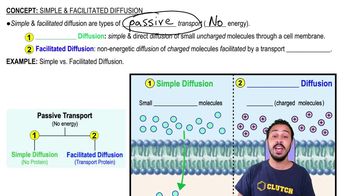
    Movement of molecules across a membrane without energy input, always occurring down a concentration gradient.
  • Concentration Gradient

    Difference in molecule concentration across a membrane, driving passive movement from high to low concentration.
  • Simple Diffusion

    Direct movement of small uncharged molecules through the membrane, requiring no proteins or energy.
  • Facilitated Diffusion

    Transport of charged or larger molecules across membranes with the help of proteins, but without energy use.
  • Transport Protein

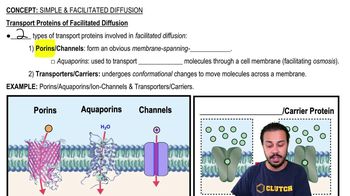
    Membrane-embedded molecule that assists in moving substances across the cell membrane during facilitated diffusion.
  • Porin

    Channel-forming protein creating a tunnel through the membrane, allowing molecules to pass freely.
  • Channel

    Membrane-spanning tunnel formed by proteins, enabling ions or molecules to move across the membrane.
  • Aquaporin

    Specialized channel protein that accelerates water movement across the membrane, enhancing osmosis.
  • Transporter

    Carrier protein that changes shape to move molecules across the membrane, only open to one side at a time.
  • Carrier

    Protein facilitating molecule movement by undergoing conformational changes, not forming a continuous tunnel.
  • Osmosis

    Diffusion of water across a semi-permeable membrane, often enhanced by aquaporins.
  • Ion

    Charged particle that requires protein facilitation to cross the cell membrane during passive transport.
  • Phospholipid

    Membrane component forming a bilayer, allowing small uncharged molecules to pass during simple diffusion.
  • Conformational Change

    Structural shift in a protein enabling the transfer of molecules across the membrane in facilitated diffusion.