What is the value of using a simple stain in microbiology?
Simple staining increases contrast in bright field microscopy, making it easier to visualize cells. It uses a single dye—either a basic dye to stain the inside of cells or an acidic dye to stain the background—allowing for clear observation of cell shape, size, and arrangement.
What charge does the inside of a bacterial cell have compared to the outside?
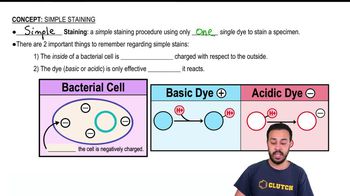
The inside of a bacterial cell is negatively charged, while the outside is more positively charged.
How do basic dyes interact with bacterial cells during simple staining?
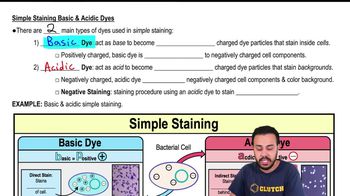
Basic dyes are positively charged and are attracted to the negatively charged components inside bacterial cells, staining the cell directly.
Why are acidic dyes referred to as indirect stains in simple staining?
Acidic dyes are negatively charged and repel the negatively charged cell components, staining the background instead of the cell itself.
What is negative staining and which type of dye is used for it?
Negative staining uses acidic dyes to stain the background of the cell, leaving the cell itself unstained.
How does a basic dye become positively charged after reacting?
A basic dye acts as a base by picking up hydrogen ions, which are positively charged, making the dye itself positively charged.
What happens to an acidic dye after it releases a hydrogen ion?
After releasing a hydrogen ion, the acidic dye becomes more negatively charged.
Why are basic dyes also called direct stains?
Basic dyes are called direct stains because they directly stain the inside of the cell by binding to its negatively charged components.
What visual effect does simple staining have on cells under a bright field microscope?
Simple staining increases the contrast, making cells easier to visualize under a bright field microscope.
How can you remember the charge of basic and acidic dyes based on their names?
The 'b' in basic resembles the 'p' in positive, indicating basic dyes are positively charged, while the 'a' in acidic reminds you of 'negative,' indicating acidic dyes are negatively charged.