Skip to main content
Microbiology
My Course
Learn
Exam Prep
AI Tutor
Study Guides
Textbook Solutions
Flashcards
Explore
Try the app
My Course
Learn
Exam Prep
AI Tutor
Study Guides
Textbook Solutions
Flashcards
Explore
Try the app
Back
Smallpox definitions
You can tap to flip the card.
Variola Virus
You can tap to flip the card.
👆
Variola Virus
A double-stranded DNA member of Orthopoxvirus responsible for a deadly systemic infection marked by severe skin lesions.
Track progress
Control buttons has been changed to "navigation" mode.
1/15
Related flashcards
Related practice
Recommended videos
Smallpox quiz
Smallpox
15 Terms
Smallpox
29. Microbial Infections - Skin and Eyes
4 problems
Topic
Conjunctivitis
29. Microbial Infections - Skin and Eyes
4 problems
Topic
29. Microbial Infections - Skin and Eyes - Part 1 of 2
4 topics
8 problems
Chapter
29. Microbial Infections - Skin and Eyes - Part 2 of 2
1 topic
2 problems
Chapter
05:16
Smallpox
201
views
3
rank
Terms in this set (15)
Hide definitions
Variola Virus
A double-stranded DNA member of Orthopoxvirus responsible for a deadly systemic infection marked by severe skin lesions.
Orthopoxvirus
A viral genus including the agent of smallpox, known for causing significant human diseases with characteristic rashes.
Airborne Transmission
A mode of disease spread involving inhalation of respiratory droplets released by infected individuals.
Direct Contact
A transmission route involving physical interaction with infected lesions or contaminated materials.
Upper Respiratory Tract
The initial site of infection for smallpox before systemic dissemination to organs and skin.
Systemic Spread
The process by which a pathogen moves from the entry site to multiple organs via blood and lymph.
Pustules
Fluid-filled skin lesions that evolve during infection, eventually leading to severe scarring.
Scarring
Permanent skin changes resulting from the healing of characteristic lesions after infection.
Fatality Rate
The proportion of deaths among infected individuals, notably high in unvaccinated cases of this disease.
Vaccination
A preventive measure that induces immunity, ultimately responsible for the global eradication of smallpox.
Adaptive Immunity
A defense mechanism developed after exposure or immunization, providing long-term protection against reinfection.
Supportive Care
Medical management focused on symptom relief and patient isolation in the absence of specific antiviral therapy.
Serological Testing
A diagnostic approach detecting antibodies or viral components to confirm infection.
Skin Lesions
Visible changes on the skin, including rashes and pustules, used for clinical diagnosis of this disease.
Eradication
The complete and permanent worldwide removal of a disease, achieved for smallpox in 1980.
 BackBack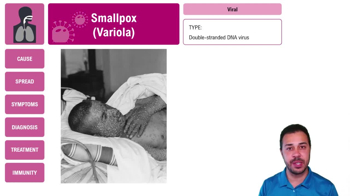
 05:16
05:16