Skip to main content
Microbiology
My Course
Learn
Exam Prep
AI Tutor
Study Guides
Textbook Solutions
Flashcards
Explore
Try the app
My Course
Learn
Exam Prep
AI Tutor
Study Guides
Textbook Solutions
Flashcards
Explore
Try the app
Back
The Ames Test definitions
You can tap to flip the card.
Ames Test
You can tap to flip the card.
👆
Ames Test
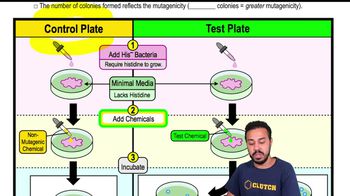
A screening experiment that assesses if a chemical induces DNA mutations by measuring bacterial colony growth.
Track progress
Control buttons has been changed to "navigation" mode.
1/15
Related flashcards
Related practice
Recommended videos
The Ames Test quiz #1
The Ames Test
10 Terms
The Ames Test
16. Microbial Genetics
3 problems
Topic
Brendan
Introduction to DNA Repair
16. Microbial Genetics
2 problems
Topic
Nicole
16. Microbial Genetics - Part 1 of 2
9 topics
14 problems
Chapter
Monica
16. Microbial Genetics - Part 2 of 2
8 topics
13 problems
Chapter
Nicole
06:59
The Ames Test
1662
views
18
rank
Terms in this set (15)
Hide definitions
Ames Test
A screening experiment that assesses if a chemical induces DNA mutations by measuring bacterial colony growth.
Mutagen
A chemical agent capable of causing changes in DNA, leading to genetic mutations.
Mutation
A change in the DNA sequence that can alter cellular function or characteristics.
Minimal Media
A nutrient agar lacking specific components, such as Histidine, used to select for certain bacterial phenotypes.
Histidine
An amino acid required for the growth of certain bacteria, absent in the test's minimal media.
His- Bacteria
Bacterial cells unable to synthesize Histidine, requiring it from their environment to grow.
His+ Bacteria
Bacterial cells capable of synthesizing Histidine, allowing growth on media lacking this amino acid.
Control Plate
An experimental setup where a known non-mutagenic chemical is added to compare baseline mutation rates.
Test Plate
An experimental setup where the chemical under investigation is added to assess its mutagenic potential.
Colony
A visible cluster of bacterial cells originating from a single progenitor, indicating successful growth.
Spontaneous Mutation
A naturally occurring genetic change that arises without exposure to external mutagens.
Induced Mutation
A genetic change triggered by exposure to a chemical agent, such as a mutagen.
Mutagenicity
The degree to which a substance increases the frequency of mutations in a test organism.
Prototroph
A bacterial strain capable of synthesizing all compounds needed for growth, such as His+ cells.
Experimental Group
The set of samples exposed to the chemical being tested for mutagenic effects.
 BackBack
 06:59
06:59