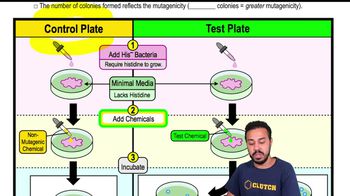
The purpose of the Ames test is to determine if a chemical is a mutagen, meaning it can induce mutations in DNA. The test measures the ability of a chemical to cause mutations that revert His- bacteria to His+, allowing them to grow on media lacking histidine. An increased number of His+ colonies indicates the chemical is mutagenic.
What type of media is used in the Ames test and what key nutrient does it lack?
Minimal media agar plates are used in the Ames test, and they lack the amino acid histidine.
Which bacterial phenotype is able to grow on the minimal media used in the Ames test?
Only histidine prototrophs (His+ cells) can grow on the minimal media because they do not require external histidine.
Why do His- bacteria generally not grow on the minimal media in the Ames test?
His- bacteria require histidine to grow, and since the minimal media lacks histidine, they cannot grow unless they mutate to His+.
What causes the appearance of a few His+ colonies on the control plate in the Ames test?
A few His+ colonies appear on the control plate due to spontaneous mutations that revert His- bacteria to His+.
How does the number of His+ colonies on the test plate indicate mutagenicity?
A large number of His+ colonies on the test plate suggests the chemical is a mutagen, as it induces mutations converting His- to His+.
What is the role of the control plate in the Ames test?
The control plate is used to measure the baseline level of spontaneous mutations by adding a known non-mutagenic chemical.
What conclusion can be drawn if the test plate shows a similar number of His+ colonies as the control plate?
If the test plate has a similar number of His+ colonies as the control, the chemical being tested is likely not a mutagen.
How does the Ames test distinguish between spontaneous and induced mutations?
The control plate shows spontaneous mutations, while the test plate reveals induced mutations if the chemical is a mutagen.
What does a higher number of His+ colonies on the test plate compared to the control plate suggest about the test chemical?
It suggests that the test chemical is mutagenic and increases the mutation rate in His- bacteria.