The Trp Operon quiz #1 Flashcards

The Trp Operon quiz #1
Control buttons has been changed to "navigation" mode.
1/10
  • When are E. coli bacteria most likely to express the genes of the trp operon?
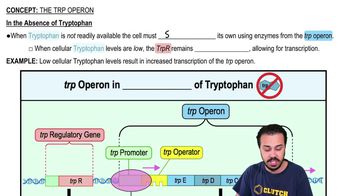
    E. coli are most likely to express the genes of the trp operon when tryptophan levels are low or absent in the environment. In these conditions, the trp repressor remains inactive because there is no tryptophan to act as a corepressor, allowing RNA polymerase to bind to the promoter and initiate transcription of the operon for tryptophan synthesis.
  • What is the function of the five genes (trpE, trpD, trpC, trpB, trpA) in the trp operon?
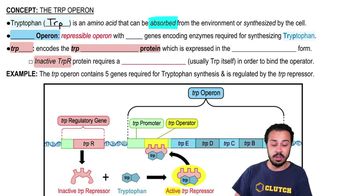
    These five genes encode enzymes required for synthesizing tryptophan from scratch in the cell.
  • What role does the trpR gene play in the regulation of the trp operon?
    The trpR gene encodes the trp repressor protein, which regulates transcription of the trp operon.
  • How does tryptophan act as a corepressor in the trp operon system?
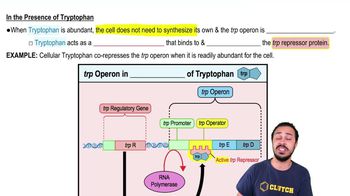
    Tryptophan binds to the inactive trp repressor protein, activating it so it can bind to the operator and repress transcription.
  • What happens to the trp repressor protein when tryptophan is absent?
    The trp repressor protein remains inactive and cannot bind to the operator, allowing transcription to proceed.
  • Where does RNA polymerase bind in the trp operon to initiate transcription?
    RNA polymerase binds to the trp promoter region to initiate transcription of the operon.
  • What is the effect of abundant environmental tryptophan on the trp operon?
    Abundant tryptophan activates the trp repressor, which binds to the operator and inhibits transcription of the operon.
  • Why is the trp operon considered a repressible operon?
    It is usually active but can be turned off (repressed) when tryptophan is present, preventing unnecessary synthesis.
  • What prevents the trp repressor from binding to the operator in low tryptophan conditions?
    Without tryptophan as a corepressor, the trp repressor remains inactive and cannot bind to the operator.
  • How does the cell respond when tryptophan levels are low in the environment?
    The trp operon is activated, allowing the cell to transcribe and translate enzymes needed to synthesize its own tryptophan.