Skip to main content
Microbiology
My Course
Learn
Exam Prep
AI Tutor
Study Guides
Textbook Solutions
Flashcards
Explore
Try the app
My Course
Learn
Exam Prep
AI Tutor
Study Guides
Textbook Solutions
Flashcards
Explore
Try the app
Back
Trachoma definitions
You can tap to flip the card.
Trachoma
You can tap to flip the card.
👆
Trachoma
A chronic ocular infection by specific Chlamydia trachomatis serotypes, leading to inflammation, scarring, and preventable blindness.
Track progress
Control buttons has been changed to "navigation" mode.
1/15
Related flashcards
Related practice
Recommended videos
Trachoma quiz
Trachoma
15 Terms
Trachoma
29. Microbial Infections - Skin and Eyes
4 problems
Topic
Conjunctivitis
29. Microbial Infections - Skin and Eyes
4 problems
Topic
29. Microbial Infections - Skin and Eyes - Part 1 of 2
4 topics
8 problems
Chapter
29. Microbial Infections - Skin and Eyes - Part 2 of 2
1 topic
2 problems
Chapter
04:32
Trachoma
176
views
3
rank
01:28
Trachoma Example 1
157
views
1
rank
Terms in this set (15)
Hide definitions
Trachoma
A chronic ocular infection by specific Chlamydia trachomatis serotypes, leading to inflammation, scarring, and preventable blindness.
Chlamydia trachomatis
A gram-negative, coccoid bacterium with ocular serotypes responsible for eye infections distinct from those causing genital disease.
Serotype
A distinct variant within a bacterial species, identified by unique surface antigens, determining tissue tropism and disease type.
Conjunctiva
A thin, transparent tissue lining the inner eyelids and covering the white part of the eye, often targeted in ocular infections.
Inflammation
A protective tissue response characterized by redness, swelling, and discomfort, often resulting from infection or injury.
Pus discharge
A thick, yellowish fluid composed of dead cells and bacteria, commonly seen in bacterial eye infections.
Scarring
The formation of fibrous tissue replacing normal tissue after chronic injury or inflammation, potentially impairing organ function.
Trichiasis
A condition where eyelashes turn inward, causing them to rub against and damage the cornea, often due to eyelid scarring.
Cornea
The transparent, dome-shaped front part of the eye that covers the iris and pupil, essential for focusing vision.
Fomite
An inanimate object or surface capable of transmitting infectious agents between individuals, such as towels or bedding.
Azithromycin
An oral antibiotic effective against Chlamydia trachomatis, commonly used to treat systemic and ocular bacterial infections.
Visual inspection
A diagnostic approach relying on direct observation of physical signs, often used where laboratory resources are limited.
Conjunctival swab
A diagnostic sample collected from the eye's conjunctiva to detect the presence of infectious organisms.
Immunity
The body's defense capability against reinfection, which remains incomplete in certain chronic bacterial diseases.
Surgery
A medical intervention to correct anatomical deformities, such as eyelid changes, and prevent further ocular damage.
 BackBack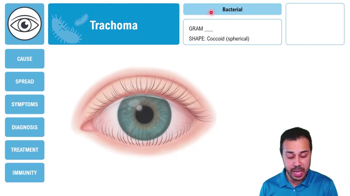
 04:32
04:32