Skip to main content
Microbiology
My Course
Learn
Exam Prep
AI Tutor
Study Guides
Textbook Solutions
Flashcards
Explore
Try the app
My Course
Learn
Exam Prep
AI Tutor
Study Guides
Textbook Solutions
Flashcards
Explore
Try the app
Back
Type III Hypersensitivities definitions
You can tap to flip the card.
Type III Hypersensitivity
You can tap to flip the card.
👆
Type III Hypersensitivity
Immune response where antibody-antigen clusters deposit in tissues, activating inflammation and causing tissue damage.
Track progress
Control buttons has been changed to "navigation" mode.
1/15
Related flashcards
Related practice
Recommended videos
Type III Hypersensitivities quiz
Type III Hypersensitivities
15 Terms
Type III Hypersensitivities
27. Immunological Disorders
5 problems
Topic
Type IV Hypersensitivities
27. Immunological Disorders
5 problems
Topic
27. Immunological Disorders - Part 1 of 2
4 topics
11 problems
Chapter
27. Immunological Disorders - Part 2 of 2
4 topics
6 problems
Chapter
02:22
Steps of Immune Complex- Mediated Hypersensitivity
152
views
1
rank
01:20
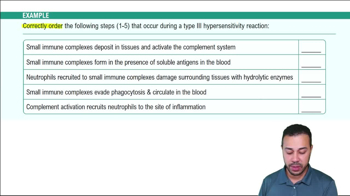
Type III Hypersensitivities Example 1
133
views
3
rank
04:21
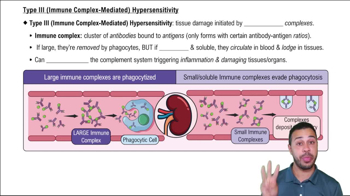
Type III (Immune Complex-Mediated) Hypersensitivity
233
views
3
rank
Terms in this set (15)
Hide definitions
Type III Hypersensitivity
Immune response where antibody-antigen clusters deposit in tissues, activating inflammation and causing tissue damage.
Immune Complex
Cluster of antibodies bound to antigens that can deposit in tissues and trigger inflammation if not cleared.
Phagocytosis
Process by which immune cells engulf and remove immune complexes, preventing tissue deposition.
Complement System
Cascade of proteins activated by immune complexes, leading to inflammation and tissue injury.
Inflammation
Tissue response marked by redness, pain, and swelling, often resulting from immune complex deposition.
Glomerulonephritis
Kidney disorder caused by immune complexes lodging in glomeruli, leading to inflammation and impaired function.
Rheumatoid Arthritis
Chronic autoimmune disease with joint inflammation due to immune complexes accumulating in synovial tissues.
Systemic Lupus Erythematosus
Autoimmune disorder where autoantibodies form complexes with nuclear antigens, causing widespread tissue damage.
Arthus Reaction
Localized tissue inflammation at antigen injection sites due to immune complex formation.
Serum Sickness
Systemic reaction with rash and inflammation from immune complexes formed after exposure to foreign proteins.
Neutrophil Degranulation
Release of enzymes from immune cells at sites of immune complex deposition, contributing to tissue injury.
Autoantibody
Antibody directed against self-antigens, often leading to chronic immune complex formation.
Self Antigen
Body’s own molecule that can be targeted by antibodies, contributing to autoimmune complex diseases.
Adaptive Immunity
Immune defense involving specific recognition of antigens, sometimes leading to hypersensitivity reactions.
Tissue Deposition
Process where immune complexes settle in organs or tissues, initiating local or systemic inflammation.
 BackBack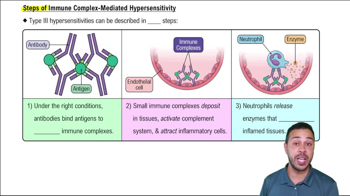
 02:22
02:22