 Back
Backchapter 20 study guide
 05:33
05:33
Terms in this set (20)
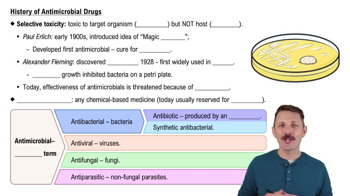
Antibiotics are commonly sourced from Streptomyces (soil bacteria), Bacillus species, and Penicillium (a fungus).
Selective toxicity means an antimicrobial kills or inhibits microbes without harming the host cells.
An antibiotic is a natural or synthetic chemical that kills or inhibits bacteria.
Broad spectrum antibiotics act against many bacteria types; narrow spectrum target specific bacteria.
A superinfection occurs when broad spectrum antibiotics kill normal flora, allowing resistant pathogens to grow.
Bactericidal drugs kill bacteria; bacteriostatic drugs inhibit bacterial growth.
MIC is the minimum inhibitory concentration that stops growth; MBC is the minimum bactericidal concentration that kills bacteria.
They target specific pathogens, reducing damage to normal flora and lowering superinfection risk.
They can disrupt normal flora and promote resistance and superinfections.
Consider pathogen identity, drug toxicity, drug concentration at infection site, patient health, and cost.
Inhibit cell wall synthesis, protein synthesis, nucleic acid synthesis, cell membrane integrity, or metabolic pathways.
Penicillin inhibits bacterial cell wall synthesis by blocking peptidoglycan cross-linking.
Tetracycline binds the 30S ribosomal subunit, blocking tRNA attachment and protein synthesis.
Because human cells are eukaryotic, making it hard to target pathogens without harming host cells.
They inhibit viral entry, replication, or release from host cells.
Inhibiting viral entry, blocking viral RNA polymerase, and preventing viral protease activity.
Disk diffusion (Kirby-Bauer), broth dilution for MIC, and MBC tests.
Drug resistance is when microbes survive antimicrobial treatment due to genetic changes or acquired mechanisms.
Enzymatic drug inactivation, target modification, decreased permeability, and efflux pumps.
Overuse, misuse of antibiotics, incomplete treatment courses, and use in agriculture.