 Back
BackFundamentals and History of Microbiology
 03:36
03:36

Terms in this set (20)
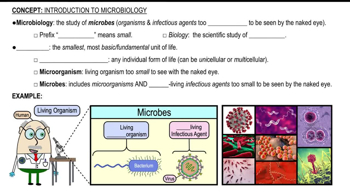
Microbiology is the study of microscopic organisms such as bacteria, viruses, fungi, algae, and protozoa.
Microbes are excellent models for understanding cellular processes in both unicellular and multicellular organisms.
1. Understanding basic life processes.
2. Applying that knowledge to benefit humans in medicine, agriculture, and industry.
People believed life could form spontaneously from non-living materials and that diseases were caused by sins, bad odors, or spirits.
The outdated belief that living organisms could develop from non-living materials.
Aristotle believed living organisms came from non-living things.
He described that disease was caused by a minute 'seed' or 'germ'.
He proposed that disease may be a biological phenomenon governed by natural laws, not magic.
Louis Pasteur is known as the Father of Modern Microbiology and Bacteriology.
He disproved spontaneous generation by showing sterile broth remains free of microbes if dust is excluded, and discovered bacterial endospores.
He demonstrated the role of bacteria in causing disease and developed techniques for isolating bacteria in pure culture.
Criteria to prove a microorganism causes a disease: found in sick but not healthy individuals, isolated in pure culture, causes disease in healthy host, and re-isolated from infected host.
Fanne Eilshemius Hesse proposed agar use, which was superior to gelatin for solidifying culture media.
Vaccination is the use of a virus (cowpox) to protect against smallpox, pioneered by Edward Jenner.
He proposed the phagocytic theory of immunity, showing white blood cells engulf bacteria to protect against disease.
He discovered the dye Trypan Red was active against sleeping sickness and introduced Salvarsan to treat syphilis, founding chemotherapy.
Waksman discovered streptomycin, the first antibiotic effective against tuberculosis.
The discovery of microbial causes of disease and development of vaccines and antibiotics, led by Pasteur and Koch.
Studying genetic code, DNA regulation, and protein synthesis in microorganisms to understand life processes.
They have short life spans, genetic homogeneity, and simpler structures, making them good models for physiological and biochemical studies.