 Back
BackFundamentals of Microbiology
 03:36
03:36

Terms in this set (22)
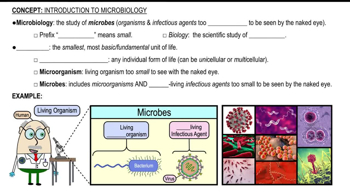
Microbiology is the study of microorganisms, including bacteria, viruses, fungi, protozoa, and algae.
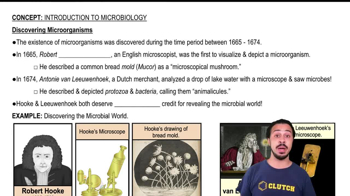
Leeuwenhoek was the first to observe and describe microorganisms using a simple microscope, founding microbiology.
The major groups include bacteria, viruses, fungi, protozoa, and algae.
Microbes can cause disease, aid digestion, produce food and medicines, and recycle nutrients in the environment.
Redi disproved spontaneous generation by showing that maggots on meat came from flies, not the meat itself.
Needham claimed spontaneous generation occurred after boiling broth, but he failed to fully sterilize it.
Spallanzani improved Needham’s experiment by boiling broth longer and sealing flasks, showing no microbial growth.
Pasteur used swan-neck flasks to disprove spontaneous generation, proving microbes come from other microbes.
Observation, question, hypothesis, experiment, analysis, and conclusion.
Koch’s postulates are criteria to prove a specific microbe causes a particular disease.
Pasteur developed pasteurization, vaccines, and disproved spontaneous generation.
Gram developed the Gram stain, a method to classify bacteria by cell wall properties.
Semmelweis introduced handwashing to reduce puerperal fever in hospitals.
Lister pioneered antiseptic surgery using carbolic acid to reduce infections.
Nightingale improved hospital sanitation and nursing practices, reducing mortality.
Snow traced a cholera outbreak to contaminated water, founding epidemiology.
Jenner developed the first vaccine using cowpox to prevent smallpox.
Ehrlich developed chemotherapy and the concept of a magic bullet to target microbes.
Microbiology helps in medicine, agriculture, food production, and environmental management.
PPE protects microbiologists from exposure to harmful microbes in the lab.
Proper handwashing removes microbes and reduces disease transmission.
Microscopes should be cleaned, covered, and stored properly to maintain function and prevent damage.