 Back
BackMicrobial Genetics: DNA Replication, Transcription, and Translation
 05:45
05:45
Terms in this set (21)
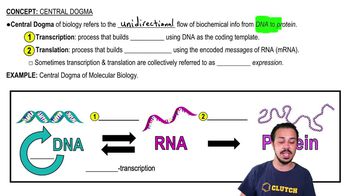
The flow of genetic information from DNA to RNA (transcription) and then to protein (translation).
Bacteria usually have a single circular chromosome made of DNA and associated proteins, often supercoiled.
The two DNA strands run in opposite directions: one strand runs 5' to 3', the other 3' to 5'.
Helicase unwinds the double-stranded DNA helix, separating the strands to form the replication fork.
The leading strand is synthesized continuously in the 5' to 3' direction by DNA polymerase, starting from an RNA primer.
Short DNA fragments synthesized discontinuously on the lagging strand during DNA replication.
DNA polymerase removes RNA primers and DNA ligase joins the Okazaki fragments covalently.
Hydrolysis of the phosphate bonds of nucleoside triphosphates (dNTPs) provides energy for DNA synthesis.
Relaxes supercoiling ahead of the replication fork to prevent DNA tangling.
The synthesis of a complementary mRNA strand from a DNA template.
RNA polymerase binds to the promoter and synthesizes RNA in the 5' to 3' direction using DNA as a template.
Initiation: RNA polymerase binds promoter; Elongation: RNA strand is synthesized; Termination: RNA polymerase stops at terminator sequence.
Eukaryotic transcription occurs in the nucleus and involves a TATA box and multiple transcription factors; prokaryotic transcription occurs in the cytoplasm without introns.
Exons are coding regions of genes; introns are noncoding regions removed during mRNA processing in eukaryotes.
The process of synthesizing proteins by decoding mRNA codons into amino acids.
A sequence of three mRNA nucleotides that codes for a specific amino acid or a stop signal.
AUG is the start codon and codes for methionine.
UAA, UAG, and UGA signal termination of translation.
tRNA transports amino acids to the ribosome and has an anticodon that base-pairs with mRNA codons.
Amino acids are joined by peptide bonds to form a growing polypeptide chain.
In bacteria, translation can begin on mRNA while transcription is still in progress due to lack of nuclear membrane.