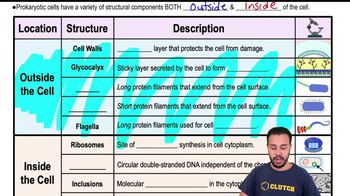
Locomotion/motility organelles that rotate from the basal body; composed of flagellin protein. Types include monotrichous, amphitrichous, lophotrichous, and peritrichous.
Axial filaments
Found in spirochetes, anchored at one end and wrapped around the cell, producing a corkscrew motion for movement.
Pili (fimbriae)
Hair-like structures on many Gram-negative bacteria used for adherence to surfaces and DNA transfer during conjugation.
Bacterial cell wall composition
Made of peptidoglycan (N-acetyl glucosamine and N-acetyl muramic acid) with tetrapeptide side chains and peptide cross bridges.
Gram-positive cell wall
Thick, multilayered peptidoglycan that stains blue/purple with Gram stain.
Gram-negative cell wall
Thin peptidoglycan layer with an outer membrane containing lipids and sometimes Lipid A endotoxin; stains pink.
Bacterial cell membrane
Phospholipid bilayer without sterols; functions in ATP synthesis, selective permeability, and photosynthesis in some bacteria.
Nucleoid
Region containing circular, double-stranded DNA without a nuclear membrane or histones, attached to the cell membrane.
Plasmids
Small circular DNA molecules independent of the chromosome; can carry genes like antibiotic resistance and replicate independently.
Bacterial ribosomes
70S ribosomes composed of proteins and rRNA; target of some antibiotics; smaller than eukaryotic 80S ribosomes.
Endospores
Dormant, resistant structures formed by some bacteria (e.g., Clostridium, Bacillus) to survive adverse conditions; formed by sporulation.
Capsule (glycocalyx)
Mucopolysaccharide layer external to the cell wall that protects bacteria from host defenses like phagocytosis.
Bacterial shapes: Cocci
Round-shaped bacteria; arrangements include diplococci, streptococci, and staphylococci.
Bacterial shapes: Bacilli
Rod-shaped bacteria; arrangements include single bacilli, diplobacilli, and streptobacilli.
Bacterial shapes: Spiral
Includes vibrio (curved rods), spirillum (rigid spirals), and spirochetes (flexible spirals).
Psychrophiles
Cold-loving bacteria with optimum growth at about 15°C; found in polar regions and deep oceans.
Mesophiles
Bacteria that grow best at moderate temperatures (25–40°C); most common cause of food spoilage and disease.
Thermophiles
Heat-loving bacteria with optimum growth at 50–60°C; found in hot springs and sunlit areas.
Osmotic pressure effects on bacteria
Hypotonic solutions cause swelling and bursting; hypertonic solutions cause plasmolysis and inhibit growth.
Bacterial oxygen requirements
Categories include strict aerobes (require O2), strict anaerobes (no O2), facultative anaerobes (with or without O2), and microaerophiles (low O2).
Binary fission
Primary method of bacterial reproduction; involves cell division with an average generation time of 1–3 hours.
Bacterial growth phases
Lag phase (preparation), log phase (rapid growth), stationary phase (equilibrium), and death phase (decline).
Genetic recombination methods
Includes transformation (uptake of DNA), conjugation (DNA transfer via pili), and transduction (DNA transfer via bacteriophages).
Transformation in bacteria
Uptake of free DNA fragments or plasmids from the environment by a bacterial cell of the same species.
Conjugation
Direct transfer of DNA between bacterial cells via pili; involves F+ (donor) and F- (recipient) cells.
Transduction
Transfer of bacterial DNA from one cell to another by a virus (bacteriophage) acting as a vector.
 Back
 05:59
