 Back
BackMicrobiology CH 1
 03:36
03:36

Terms in this set (28)
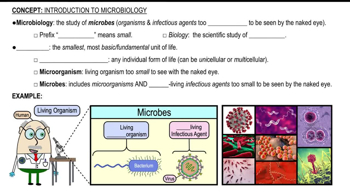
Microbiology is the study of microorganisms or microbes, including cellular living organisms like bacteria, archaea, fungi, protists, helminths, and nonliving entities like viruses and prions.
Prokaryotic cells evolved about 3.5 billion years ago and include unicellular bacteria and archaea, which are the earliest life forms.
Eukaryotic cells include all multicellular organisms and some unicellular microorganisms like amoebae and yeast, explained by the endosymbiotic theory.
Living: Bacteria, Archaea, Protists, Fungi, Helminths. Nonliving: Viruses and Prions.
The germ theory states that microbes cause infectious diseases, proven by Robert Koch through isolation and cultivation of bacteria like Bacillus anthracis.
Criteria to establish a causative relationship between a microbe and a disease, including isolation, cultivation, and reproduction of disease in a healthy host.
Spontaneous generation is the disproven idea that life arises from nonliving matter; biogenesis states life arises from existing life, proven by Louis Pasteur.
Procedures like hand washing, sterilizing instruments, and wearing gloves to prevent contamination and healthcare-acquired infections.
Steps include asking a question, proposing a hypothesis, collecting data, analyzing results, and drawing conclusions to support or refute the hypothesis.
An observation is data collected through senses or instruments; a conclusion interprets observations to form a judgment.
A law predicts what happens (often mathematically), while a theory explains how and why phenomena occur, both subject to ongoing testing.
Taxonomy classifies organisms by shared features; hierarchy: Domain, Kingdom, Phylum, Class, Order, Family, Genus, Species.
Domains: Bacteria (unicellular prokaryotes), Archaea (extremophiles, no known pathogens), and Eukarya (unicellular and multicellular eukaryotes).
A two-name system for scientific names: Genus (capitalized) and species (lowercase), both italicized, e.g., Escherichia coli.
Types: Parasitism (harm host), Mutualism (both benefit), Commensalism (one benefits, other unaffected).
The collection of microbes residing on and in the human body, often mutualistic, aiding immune training, vitamin production, and digestion.
Sticky microbial communities attached to surfaces, protected by a matrix, often resistant to antibiotics and immune responses.
A process of heating liquids to 50–60°C to kill yeast and bacteria, preventing spoilage, developed by Louis Pasteur.
Growth media support microbial growth; types include broths, plates, slants, and deeps, often solidified with agar.
A differential stain classifying bacteria as Gram-positive (thick peptidoglycan, purple) or Gram-negative (thin peptidoglycan, pink) based on cell wall structure.
Identifies bacteria with waxy mycolic acid cell walls (e.g., Mycobacterium), retaining red dye after acid wash, important for diagnosing tuberculosis.
Immersion oil matches the refractive index of glass to reduce light scattering and improve resolution at 100x objective magnification.
TEM provides 2D internal images; SEM scans surfaces for 3D images, both with much higher resolution than light microscopy.
Uses fluorochromes that absorb UV light and emit visible light to detect specific molecules or microbes, including immunofluorescence with antibody-linked dyes.
A culture containing only one species of microbe, isolated from a mixed sample using aseptic techniques.
A method to isolate single colonies of microbes on agar plates by spreading a sample to dilute cells.
Staining techniques using one dye (e.g., methylene blue) to determine size, shape, and arrangement of cells.
Stains highlighting specific cell structures like flagella, capsules, and endospores using combinations of dyes and mordants.