Skip to main content
Microbiology
My Course
Learn
Exam Prep
AI Tutor
Study Guides
Textbook Solutions
Flashcards
Explore
Try the app
My Course
Learn
Exam Prep
AI Tutor
Study Guides
Textbook Solutions
Flashcards
Explore
Try the app
Back
Microbiology: Immune System and Immune Responses
You can tap to flip the card.
What is an immune response?
You can tap to flip the card.
👆
What is an immune response?
A
physiological process
coordinated by the immune system to eliminate antigens.
Track progress
Control buttons has been changed to "navigation" mode.
1/28
Recommended videos
05:52
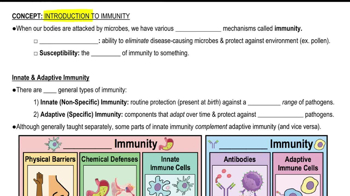
Innate vs. Adaptive Immunity
3974
views
86
rank
02:58
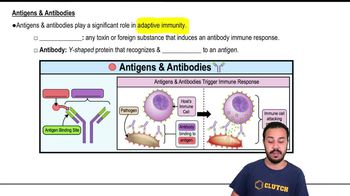
Antigens & Antibodies
2550
views
96
rank
Terms in this set (28)
Hide definitions
What is an immune response?
A
physiological process
coordinated by the immune system to eliminate antigens.
Define innate immunity.
Inborn, nonspecific immunity
found in all eukaryotes with generalized responses to pathogens.
Define adaptive immunity.
Immunity
only in vertebrates
that matures over time, tailors responses to pathogens, requires 4–7 days to activate, and exhibits memory.
What are the common features of innate and adaptive immunity?
Both
recognize diverse pathogens
,
eliminate identified invaders
, and
discriminate between self and foreign antigens
.
What are the three lines of immune defense?
1) Innate barrier defenses, 2) Innate cellular and molecular defenses, 3) Adaptive defense.
Examples of mechanical barriers in first-line defenses?
Tears washing pathogens from eyes, urine flushing microbes, saliva limiting adherence, mucus membranes trapping microbes, mucociliary escalator sweeping mucus from lungs.
Role of lysozyme as a chemical barrier?
An enzyme in secretions like tears and saliva that
breaks down bacterial cell walls
to attack invaders.
What are antimicrobial peptides?
Proteins that
destroy a wide spectrum
of viruses, parasites, bacteria, and fungi; example: defensins.
What is the function of the lymphatic system in immunity?
Collects, circulates, and filters fluid in body tissues before returning it to the blood, supporting immune cell function.
Primary lymphoid tissues and their roles?
Thymus (site of T cell maturation) and bone marrow (site of red and white blood cell production).
Secondary lymphoid tissues and their functions?
Lymph nodes (filter lymph), spleen (filters blood), and MALT (mucosa-associated lymphoid tissue) found in mucosal linings.
What are granulocytes?
Leukocytes with visible cytoplasmic granules, including neutrophils, eosinophils, basophils, and mast cells.
What are agranulocytes?
Leukocytes lacking visible granules, including lymphocytes, dendritic cells, and monocytes.
Role of neutrophils in immunity?
Most numerous WBCs; perform phagocytosis, release antimicrobial peptides, and are first responders to injury.
What is phagocytosis?
A process where cells engulf and digest large particles like bacteria or debris, also called 'cell eating.'
Function of eosinophils?
Contain granules with enzymes and toxins; moderate phagocytic activity; involved in combating parasites.
Role of basophils and mast cells?
Release histamine and other defense molecules; involved in allergic responses and fighting parasites.
What are cytokines?
Signaling proteins that allow cells to communicate, initiating and coordinating immune responses.
What are chemokines?
A type of cytokine that induces chemotaxis, attracting immune cells to sites of infection or injury.
How do siderophores help pathogens?
Organic molecules produced by bacteria that
sequester iron
from host iron-binding proteins to support microbial survival.
What is the complement system?
A group of >30 proteins that activate in a cascade to enhance immune defenses via opsonization, inflammation, and membrane attack complex formation.
What are the cardinal signs of inflammation?
Redness, pain, localized heat, swelling, and loss of function.
Describe the vascular changes phase of inflammation.
Blood vessels dilate and become more permeable, allowing immune cells and proteins to enter tissues; exudate accumulates to aid clotting.
What is margination in inflammation?
The process where leukocytes slow down and adhere to blood vessel walls before exiting into tissues.
What is diapedesis?
Leukocytes change shape and squeeze through blood vessel walls to reach infected or injured tissues.
How does fever protect the body?
Limits growth of heat-sensitive pathogens, enhances interferon antiviral effects, increases phagocyte efficiency, and promotes tissue repair.
How do antipyretics reduce fever?
By decreasing production of prostaglandins in the hypothalamus, which lowers the body's temperature set point.
What is chronic inflammation?
A prolonged inflammatory response that causes tissue injury and contributes to diseases like atherosclerosis and certain cancers.
 BackBack
 05:52