 Back
BackMicrobiology: Prokaryotic and Eukaryotic Cell Structures and Functions
 05:59
05:59
Terms in this set (25)
Cocci (spherical), bacilli (rod-shaped), and spirilla (spiral-shaped).
Arrangement refers to how cocci cells group together, such as chains, clusters, or pairs.
Single circular chromosome, cell wall chemicals like peptidoglycan, and reproduction by binary fission.
Multiple linear chromosomes, cell wall chemicals (varies), mitosis, membrane-bound organelles, and a nucleus with histones.
Cell membrane, cytoplasm, ribosomes, and DNA (though organized differently).
Proteins and lipid bilayer form a semi-permeable membrane for transport; described by the fluid mosaic model.
Polymer of alternating sugars NAM and NAG linked by peptide chains.
Thick peptidoglycan layer with teichoic acids.
Thin peptidoglycan layer, outer membrane with LPS (lipopolysaccharide), including O-polysaccharide and Lipid A endotoxin, plus periplasm and porins.
Contains mycolic acid, a waxy lipid that resists staining.
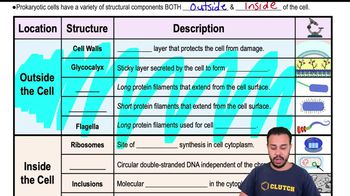
Gelatinous outer layer that protects against phagocytosis and aids in attachment.
Composed of filament, hook, and basal body made of flagellin protein.
Mono-, peri-, amphi-, and lopho- flagellation describe number and location of flagella.
Movement includes runs (CCW rotation) and tumbles (CW rotation); taxis is movement toward attractants or away from repellents via receptors.
Flagella located within the periplasmic space of spirochetes, enabling movement in viscous environments.
Attachment to surfaces, virulence factors; sex pili enable DNA transfer during conjugation.
Region containing the single circular DNA chromosome, not membrane-bound.
Prokaryotes have 70S ribosomes; eukaryotes have 80S ribosomes.
Present in eukaryotes; site of energy production via aerobic respiration.
Storage granules for nutrients or substances; help maintain osmotic balance.
Highly resistant survival structures formed by Bacillus and Clostridium; not for reproduction.
Sporulation forms a spore from a vegetative cell; germination forms a vegetative cell from a spore.
They enable survival under harsh conditions but do not function in reproduction or multiplication.
Archaea have unique cell wall chemicals; mycoplasma lack a cell wall entirely.
Gel-like space between outer membrane and plasma membrane containing enzymes and transport proteins.