 Back
BackMicrobiology Study Guide Flashcards
 03:36
03:36

Terms in this set (39)
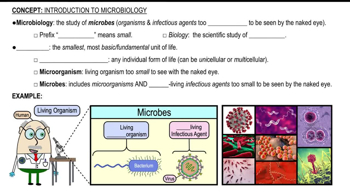
A microorganism is a microscopic organism. Microbiologists study bacteria, archaea, fungi, protozoa, algae, and viruses.
Cellular microbes have cells (e.g., bacteria, fungi). Acellular microbes lack cells (e.g., viruses, prions, viroids).
Prokaryotic cells lack a nucleus, while eukaryotic cells have a nucleus enclosed by a membrane.
Viruses (DNA or RNA with protein coat), prions (infectious proteins), and viroids (infectious RNA molecules).
False. Many microbes are harmless or beneficial, such as those in the human microbiome.
Viruses are acellular and cannot reproduce independently; they require a host cell.
It would be classified as an archaeon, a prokaryote distinct from bacteria.
By competing with pathogens for resources and stimulating the immune system.
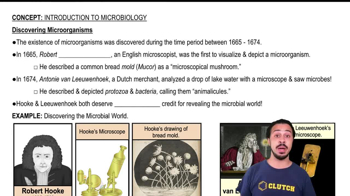
Antonie van Leeuwenhoek; he observed microorganisms using a simple microscope.
It magnifies small objects using two lenses. Total magnification = \(\text{ocular} \times \text{objective}\).
Robert Hooke coined the term cell after observing cork under a microscope.
Abiogenesis claimed life arose spontaneously from nonliving matter; it persisted due to lack of experimental evidence against it.
It showed that microbes do not arise spontaneously but come from the environment, disproving spontaneous generation.
Yeast causes alcoholic fermentation, bacteria cause acidic fermentation spoiling products.
Pasteurization is heating to kill microbes; it was developed to prevent spoilage observed in fermentation.
The curve trapped airborne microbes, allowing air but preventing contamination, proving microbes come from the environment.
Acetobacter bacteria cause acid spoilage; prevention includes pasteurization and sterile techniques.
Improved microscopy allowed visualization of microbes, supporting the idea that microbes cause disease.
The theory that microorganisms cause infectious diseases.
Four criteria to link a microbe to a disease: presence in diseased, isolation, cause disease in healthy, re-isolation.
Koch's postulates provide experimental proof supporting the germ theory of disease.
Agarose is a solidifying agent that remains solid at incubation temperatures, allowing isolation of colonies.
Isolating Mycobacterium tuberculosis from a TB patient, infecting a healthy host, and re-isolating it.
Some cannot be cultured or cause disease only in humans, making postulates hard to fulfill.
Jenner inoculated a boy with cowpox to protect against smallpox, pioneering vaccination.
An attenuated vaccine uses weakened live microbes to stimulate immunity without causing disease.
Measles, mumps, and rubella (MMR) vaccine is an example of an attenuated vaccine.
He introduced handwashing with chlorinated lime to reduce puerperal fever in hospitals.
Used carbolic acid to sterilize surgical instruments and clean wounds, reducing infections.
Selective toxicity targets microbes without harming the host, essential for safe antimicrobial drugs.
Paul Ehrlich coined the term chemotherapy for chemical treatment of disease.
Alexander Fleming discovered penicillin, produced by the mold Penicillium notatum.
Bacteria have unique structures and metabolism; viruses use host machinery, making selective targeting harder.
It was the first effective antibiotic, revolutionizing treatment of bacterial infections.
Taxonomy is the classification of organisms into classification, nomenclature, and identification.
Uses genus and species names, e.g., Escherichia coli, italicized with genus capitalized.
Carl Woese proposed it based on ribosomal RNA sequence differences among Bacteria, Archaea, and Eukarya.
Genus capitalized, species lowercase, both italicized, e.g., Genus species.
Genetic sequencing reveals evolutionary relationships not evident from morphology alone.