How do viruses differ from bacteria in structure and metabolism?
Viruses are obligate intracellular parasites lacking ribosomes, ATP metabolism, and both DNA and RNA simultaneously. Bacteria have both DNA and RNA, ribosomes, and ATP-generating metabolism.
What is a virion?
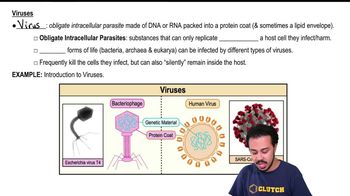
A virion is a complete, infectious viral particle composed of nucleic acid and a protein coat (capsid).
What types of nucleic acid can viral genomes have?
Viral genomes can be DNA or RNA, single- or double-stranded, linear or circular, and sometimes segmented.
What is the function of the viral capsid?
The capsid is a protein coat that protects viral nucleic acid and is made of subunits called capsomeres.
What distinguishes enveloped viruses from nonenveloped viruses?
Enveloped viruses have a lipid/protein envelope derived from the host cell membrane, while nonenveloped viruses only have a capsid.
What are viral spikes and their role?
Spikes are glycoprotein projections on the viral envelope used for attachment to host cells and identification.
Name the four main viral capsid morphologies.
Helical, polyhedral (icosahedral), enveloped, and complex (e.g., bacteriophages).
What is the Baltimore classification system based on?
It classifies viruses based on their nucleic acid type and replication strategy into seven groups.
What is a plaque-forming unit (PFU)?
PFU measures viral concentration by counting plaques formed by viruses lysing bacterial cells in culture.
How are animal viruses commonly cultured?
Animal viruses are cultured in living animals, embryonated eggs, or cell cultures, with cell cultures preferred for convenience.
What are cytopathic effects (CPE) in cell cultures?
CPE are visible changes or damage in cultured cells caused by viral infection.
Name two serological and molecular methods for viral identification.
Serological methods like ELISA detect viral antigens or antibodies; PCR amplifies viral genetic material.
What are oncogenic viruses?
Viruses that can cause cancer by integrating their genes into host DNA, altering cell growth (e.g., HPV, EBV, HBV).
What is the difference between latent and persistent viral infections?
Latent infections remain dormant without symptoms until reactivation; persistent infections continuously produce virions and worsen over time.
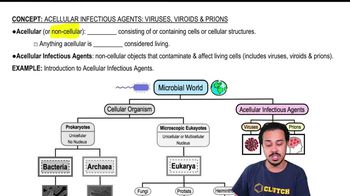
What are viroids?
Viroids are short, naked RNA molecules causing plant diseases, lacking a protein coat and replicated by host RNA polymerase.
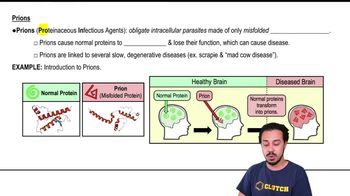
What are prions and how do they cause disease?
Prions are infectious proteins that convert normal prion proteins into abnormal forms, causing neurological diseases.
Give an example of a helical virus and its morphology.
Ebola virus is a helical virus with a rodlike shape formed by capsomeres arranged helically around nucleic acid.
What is the morphology of a T-even bacteriophage?
It has a polyhedral head containing DNA, a helical tail sheath, tail fibers, and baseplate.
How do viral plaques form in bacteriophage cultures?
Plaques form when bacteriophages infect and lyse bacterial cells, creating clear zones on a bacterial lawn.
What is the size range of viruses?
Viruses range from about 20 nm (prions) to nearly 1000 nm (Ebola virus), much smaller than most bacteria.
 Back
 03:22