Back

Economic Surplus and Efficiency definitions

Control buttons has been changed to "navigation" mode.
1/15
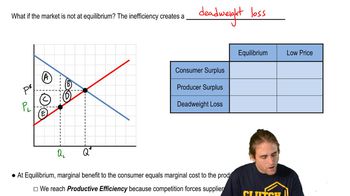
  • Economic Surplus

    Sum of benefits gained by buyers and sellers, representing total gains from trade at equilibrium.
  • Consumer Surplus

    Difference between what buyers are willing to pay and what they actually pay, shown below demand curve and above price.
  • Producer Surplus

    Difference between actual price received by sellers and their minimum acceptable price, shown above supply curve and below price.
  • Market Equilibrium

    Point where supply and demand intersect, maximizing total gains from trade and ensuring efficient allocation.
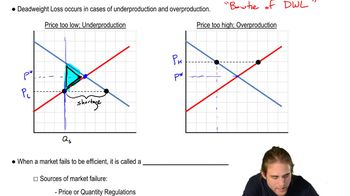
  • Deadweight Loss

    Lost gains from trade due to market inefficiency, represented by areas where beneficial exchanges do not occur.
  • Shortage

    Situation where quantity demanded exceeds quantity supplied, often caused by prices set below equilibrium.
  • Surplus

    Situation where quantity supplied exceeds quantity demanded, often caused by prices set above equilibrium.
  • Bowtie Diagram

    Graphical representation highlighting areas of lost surplus from underproduction or overproduction.
  • Allocative Efficiency

    State where resources are distributed to match consumer preferences, achieved at equilibrium quantity and price.
  • Productive Efficiency

    Condition where goods are produced at lowest possible cost, driven by competition at equilibrium.
  • Marginal Benefit

    Additional value received from consuming one more unit, reflected by willingness to pay on the demand curve.
  • Marginal Cost

    Additional expense incurred from producing one more unit, reflected by willingness to sell on the supply curve.
  • Market Failure

    Breakdown in efficiency due to factors like regulations, externalities, monopoly, or high transaction costs.
  • Externality

    Impact on third parties not involved in a transaction, such as pollution affecting neighbors of a factory.
  • Transaction Costs

    Expenses associated with making trades, which can prevent beneficial exchanges if excessively high.