Skip to main content
Microeconomics
My Course
Learn
Exam Prep
AI Tutor
Study Guides
Flashcards
Explore
Try the app
My Course
Learn
Exam Prep
AI Tutor
Study Guides
Flashcards
Explore
Try the app
Back
Four Market Model Summary: Oligopoly definitions
You can tap to flip the card.
Oligopoly
You can tap to flip the card.
👆
Oligopoly
A market structure with a small number of firms, each possessing significant influence over price and output.
Track progress
Control buttons has been changed to "navigation" mode.
1/15
Related flashcards
Related practice
Recommended videos
Four Market Model Summary: Oligopoly quiz #1
Four Market Model Summary: Oligopoly
10 Terms
Four Market Model Summary: Oligopoly
14. Oligopoly
10 problems
Topic
Kinked-Demand Theory
14. Oligopoly
10 problems
Topic
14. Oligopoly
6 topics
14 problems
Chapter
Guided course
03:39
Four Market Model Summary: Oligopoly
1802
views
14
rank
Terms in this set (15)
Hide definitions
Oligopoly
A market structure with a small number of firms, each possessing significant influence over price and output.
Barriers to Entry
Obstacles that prevent new firms from entering a market, often resulting in limited competition.
Market Power
The ability of firms to control prices and output levels due to limited competition.
Demand Curve
A graphical representation showing how quantity demanded varies with price, typically downward sloping in this context.
Marginal Revenue
The additional income received from selling one more unit, always below price in this market structure.
Marginal Cost
The extra expense incurred from producing one additional unit, often less than price in this market.
Profit Maximization
A process involving strategic decisions based on competitors’ actions rather than simple cost-revenue comparisons.
Long Run Profitability
The potential for sustained earnings over time due to limited competition and high entry barriers.
Game Theory
A framework used to analyze strategic interactions among firms, crucial for understanding decision-making.
Interdependence
A situation where each firm’s actions affect and are affected by the decisions of other firms in the market.
Perfect Competition
A contrasting market structure with many firms, no barriers, and price equaling marginal cost.
Monopoly
A market structure with a single firm, resulting in no competition and maximum market power.
Strategic Pricing
Setting prices based on anticipated reactions of competitors rather than solely on cost considerations.
Output
The quantity of goods produced and supplied by firms, influenced by market power and competition.
Average Revenue
The revenue earned per unit sold, represented by the demand curve and always above marginal revenue in this market.
 BackBack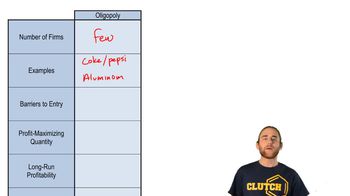
 03:39
03:39