Skip to main content
Microeconomics
My Course
Learn
Exam Prep
AI Tutor
Study Guides
Flashcards
Explore
Try the app
My Course
Learn
Exam Prep
AI Tutor
Study Guides
Flashcards
Explore
Try the app
Back
Fractions Review definitions
You can tap to flip the card.
Numerator
You can tap to flip the card.
👆
Numerator
The top value in a fraction, representing the number of parts considered out of the whole.
Track progress
Control buttons has been changed to "navigation" mode.
1/14
Related flashcards
Related practice
Recommended videos
Fractions Review quiz
Fractions Review
15 Terms
Fractions Review
0. Basic Principles of Economics
10 problems
Topic
Percentage and Decimal Review
0. Basic Principles of Economics
10 problems
Topic
0. Basic Principles of Economics
13 topics
14 problems
Chapter
Guided course
02:40
Comparing Fractions
2724
views
35
rank
Terms in this set (14)
Hide definitions
Numerator
The top value in a fraction, representing the number of parts considered out of the whole.
Denominator
The bottom value in a fraction, indicating the total number of equal parts in the whole.
Decimal
A numerical representation using a point to separate whole numbers from fractional parts, aiding comparison.
Fraction
A mathematical expression showing a part of a whole, written with two numbers separated by a line.
Division
A mathematical operation used to convert a fraction into a decimal for easier comparison.
Comparison
A process of evaluating two or more values to determine which is greater, lesser, or equal.
Equality
A condition where two values or expressions have the same numerical value.
Rounding
A method of adjusting a numerical value to a specified degree of precision, often used with decimals.
Calculator
A tool used to perform arithmetic operations, such as dividing numbers to convert fractions to decimals.
Less Than Sign
A symbol used to indicate that one value is smaller than another in a comparison.
Precision
The degree of exactness in a numerical value, especially important when comparing decimals.
Complex Fraction
A fraction with larger or less familiar numbers, making direct comparison more challenging.
Market Equilibrium
A state in economics where supply and demand are balanced, often requiring comparison of values.
Demand Curve
A graphical representation in economics showing the relationship between price and quantity demanded.
 BackBack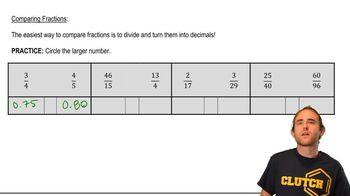
 02:40
02:40