Skip to main content
Microeconomics
My Course
Learn
Exam Prep
AI Tutor
Study Guides
Flashcards
Explore
Try the app
My Course
Learn
Exam Prep
AI Tutor
Study Guides
Flashcards
Explore
Try the app
Back
Graphs of Two Variables definitions
You can tap to flip the card.
X-axis
You can tap to flip the card.
👆
X-axis
Horizontal line on a graph representing quantity, typically increasing from left to right in economic diagrams.
Track progress
Control buttons has been changed to "navigation" mode.
1/15
Related flashcards
Related practice
Recommended videos
Graphs of Two Variables quiz #1
Graphs of Two Variables
10 Terms
Graphs of Two Variables
1. Reading and Understanding Graphs
10 problems
Topic
Relationships between Variables
1. Reading and Understanding Graphs
10 problems
Topic
1. Reading and Understanding Graphs
9 topics
15 problems
Chapter
Guided course
04:34
Plotting Points on a Graph
5760
views
110
rank
Terms in this set (15)
Hide definitions
X-axis
Horizontal line on a graph representing quantity, typically increasing from left to right in economic diagrams.
Y-axis
Vertical line on a graph representing price, usually increasing upward and used for economic conventions.
Quantity
Numerical value plotted along the horizontal axis, indicating the amount of a good or service.
Price
Numerical value plotted along the vertical axis, indicating the monetary value of a good or service.
Demand Schedule
Table listing various prices and corresponding quantities demanded, used as a basis for plotting points.
Point
Specific location on a graph where a price and quantity pair intersect, often labeled for clarity.
Pair
Combination of two values, one from each axis, used to determine a unique position on a graph.
Intersection
Spot on a graph where values from the horizontal and vertical axes meet, marking a plotted data point.
Label
Identifier, such as a letter or color, assigned to a plotted point for easy reference and tracking.
Convention
Standard practice in economics for assigning price to the vertical axis and quantity to the horizontal axis.
Graph
Visual representation with axes, used to display relationships between two variables like price and quantity.
Axis
Reference line, either horizontal or vertical, used to organize and scale values in a two-variable graph.
Vertical Axis
Line running upward on a graph, typically reserved for price in economic diagrams.
Horizontal Axis
Line running left to right on a graph, typically reserved for quantity in economic diagrams.
Plot
Process of marking a point at the intersection of two values from the axes, visually representing data.
 BackBack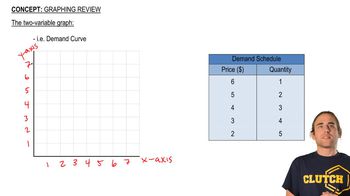
 04:34
04:34