Skip to main content
Microeconomics
My Course
Learn
Exam Prep
AI Tutor
Study Guides
Flashcards
Explore
Try the app
My Course
Learn
Exam Prep
AI Tutor
Study Guides
Flashcards
Explore
Try the app
Back
Kinked-Demand Theory definitions
You can tap to flip the card.
Oligopoly
You can tap to flip the card.
👆
Oligopoly
Market structure with few firms whose decisions are interdependent, leading to unique pricing and output behaviors.
Track progress
Control buttons has been changed to "navigation" mode.
1/15
Related flashcards
Related practice
Recommended videos
Kinked-Demand Theory quiz
Kinked-Demand Theory
15 Terms
Kinked-Demand Theory
14. Oligopoly
10 problems
Topic
Four Market Model Summary: Oligopoly
14. Oligopoly
10 problems
Topic
14. Oligopoly
6 topics
14 problems
Chapter
Guided course
13:04
Oligopoly:Kinked Demand Theory
1453
views
11
rank
Terms in this set (15)
Hide definitions
Oligopoly
Market structure with few firms whose decisions are interdependent, leading to unique pricing and output behaviors.
Kinked Demand Curve
Graphical representation with a distinct bend, reflecting different slopes based on competitors' price reactions.
Price Inflexibility
Characteristic where prices remain stable despite cost changes, due to strategic interactions among firms.
Marginal Revenue Curve
Graph showing revenue from selling one more unit, shaped uniquely in kinked-demand models with two slopes.
Marginal Cost Curve
Graph depicting the cost of producing an additional unit, interacting with marginal revenue to determine output.
Competitive Advantage
Benefit gained when a firm’s price is lower than rivals, attracting more customers and increasing sales.
Industry Quantity
Total number of goods sold by all firms in a market, affected by collective pricing decisions.
Steep Demand Curve
Section of the demand graph where quantity changes minimally in response to price shifts, often when rivals match prices.
Shallow Demand Curve
Section of the demand graph where quantity changes significantly with price shifts, typically when rivals ignore price changes.
Price Matching
Strategy where firms adjust their prices to align with competitors, reducing individual advantage.
Price Ignoring
Situation where competitors do not follow a firm’s price change, leading to shifts in market share.
Equilibrium
Stable point in the market where price and quantity remain unchanged due to mutual firm responses.
Game Theory
Analytical framework for predicting firm behavior based on possible actions and reactions of rivals.
Elasticity
Measure of how much quantity demanded responds to price changes, varying across sections of the kinked curve.
Profit Maximization
Goal of firms to achieve the highest possible profit, complicated by interdependent pricing in oligopolies.
 BackBack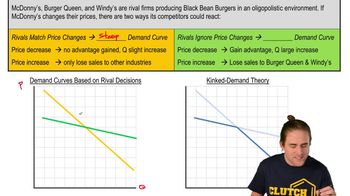
 13:04
13:04