What is the main reason the demand curve for an oligopoly is difficult to show?
The demand curve is difficult to show because firms in an oligopoly react to each other's price changes, making outcomes unpredictable.
How does the kinked-demand theory attempt to model oligopoly pricing?
It considers the most likely competitor reactions to price changes and creates a demand curve with a kink to reflect these scenarios.
What happens to the demand curve if rivals match a firm's price decrease in an oligopoly?
The demand curve becomes steeper, and the firm gains little to no competitive advantage, resulting in only a slight increase in industry quantity.
What is the effect on quantity sold if a firm lowers its price and competitors do not match the decrease?
The firm gains a significant competitive advantage, leading to a large increase in the quantity it sells.
What occurs if a firm raises its price and competitors do not follow?
The firm's quantity sold decreases significantly as customers switch to competitors with lower prices.
Why is the demand curve in the kinked-demand theory described as 'kinked'?
It has a distinct bend or 'kink' at the current price, reflecting different slopes above and below this price due to competitor reactions.
How does the kinked-demand curve explain price inflexibility in oligopolies?
Because firms have little incentive to change prices, as increases or decreases are met with competitor reactions that reduce the benefits of changing price.
What is the typical competitor reaction if a firm decreases its price in an oligopoly?
Competitors are likely to match the price decrease to avoid losing market share.
What is the typical competitor reaction if a firm increases its price in an oligopoly?
Competitors are likely to ignore the price increase, causing the firm to lose customers.
How does the marginal revenue curve appear in the kinked-demand theory?
It has a discontinuity or a sharp bend at the kink, reflecting the change in the slope of the demand curve.
What happens to production levels if marginal cost shifts within a certain range under the kinked-demand theory?
Production levels remain unchanged as long as marginal cost stays within the range defined by the kink in the marginal revenue curve.
Why do prices tend to be stable in oligopolies according to the kinked-demand theory?
Because firms have little incentive to change prices due to the risk of losing customers or profits, leading to price inflexibility.
How does the kinked-demand theory relate to game theory in oligopolies?
It reflects the strategic interdependence of firms, as each firm's best action depends on the likely reactions of its rivals.
What is the main takeaway from the kinked-demand theory for students?
The main takeaway is that the kink in the demand curve leads to price inflexibility and stable prices in oligopolies.
In the kinked-demand theory, what is the effect of a dramatic cost change on price?
Even with a dramatic cost change, firms may not change their prices if the marginal cost remains within the kinked range, maintaining equilibrium.
 Back
Back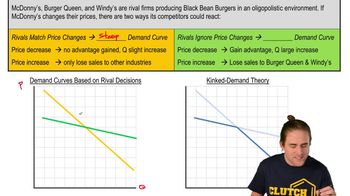
 13:04
13:04