Skip to main content
Microeconomics
My Course
Learn
Exam Prep
AI Tutor
Study Guides
Flashcards
Explore
Try the app
My Course
Learn
Exam Prep
AI Tutor
Study Guides
Flashcards
Explore
Try the app
Back
Median Voter Theorem definitions
You can tap to flip the card.
Median
You can tap to flip the card.
👆
Median
Value dividing a data set into two equal halves, with one half above and one half below.
Track progress
Control buttons has been changed to "navigation" mode.
1/15
Related flashcards
Related practice
Recommended videos
Median Voter Theorem quiz #1
Median Voter Theorem
10 Terms
Median Voter Theorem
17. Asymmetric Information, Voting, and Public Choice
9 problems
Topic
Condorcet Voting Paradox
17. Asymmetric Information, Voting, and Public Choice
10 problems
Topic
17. Asymmetric Information, Voting, and Public Choice
4 topics
15 problems
Chapter
Guided course
06:42
Median Voter Theorem
963
views
4
rank
Terms in this set (15)
Hide definitions
Median
Value dividing a data set into two equal halves, with one half above and one half below.
Median Voter Theorem
Principle stating that the option preferred by the middlemost voter will win in majority-rule elections.
Preference
Individual's ranking or desire for specific outcomes, such as budget levels, in a voting scenario.
Majority Rule
Decision-making process where the option receiving more than half the votes is selected.
Military Spending
Budget allocation for defense, used as an example to illustrate voter preferences in the lesson.
Jurisdiction
Geographical area or district where voting and policy decisions are made and can influence relocation.
Dissatisfaction
Feeling experienced by voters whose preferred outcome is not selected in the voting process.
Pacifist
Person who prefers no military spending, representing an extreme preference in the voting example.
Outcome
Final result of a voting process, determined by the aggregation of individual preferences.
Data Set
Collection of values, such as voter preferences, used to determine the median in the theorem.
Relocation
Movement of individuals to areas where collective preferences align more closely with their own.
Vote
Act of choosing between options, often selecting the one closest to personal preference.
Budget
Amount of money allocated for a specific purpose, central to the voting examples discussed.
Alignment
Tendency of voters to support options nearest to their own preferences, especially when ideal choices are unavailable.
Election
Process in which individuals express their preferences to determine a collective decision.
 BackBack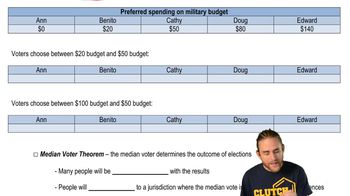
 06:42
06:42