Skip to main content
Microeconomics
My Course
Learn
Exam Prep
AI Tutor
Study Guides
Flashcards
Explore
Try the app
My Course
Learn
Exam Prep
AI Tutor
Study Guides
Flashcards
Explore
Try the app
Back
Poverty definitions
You can tap to flip the card.
Poverty Line
You can tap to flip the card.
👆
Poverty Line
Government-set income threshold varying by household size, below which families are classified as living in poverty.
Track progress
Control buttons has been changed to "navigation" mode.
1/15
Related flashcards
Related practice
Recommended videos
Poverty quiz #1
Poverty
10 Terms
Poverty
16. Income Inequality and Poverty
10 problems
Topic
Polices to Reduce Poverty
16. Income Inequality and Poverty
9 problems
Topic
16. Income Inequality and Poverty
5 topics
14 problems
Chapter
Guided course
05:02
Poverty
895
views
6
rank
Terms in this set (15)
Hide definitions
Poverty Line
Government-set income threshold varying by household size, below which families are classified as living in poverty.
Household Size
Number of individuals in a family unit, affecting the income threshold for poverty classification.
Poverty Rate
Percentage of the population living below the poverty threshold at a given time.
In-Kind Transfers
Non-cash benefits such as food stamps or healthcare, excluded from official income calculations for poverty.
Recession
Economic downturn periods marked by increased poverty rates and reduced overall income levels.
Discrimination
Social bias contributing to higher poverty rates among certain racial or ethnic groups.
Family Composition
Structure of a household, such as single female-headed families, influencing poverty likelihood.
Credit Constraint
Limited access to loans for poor individuals due to perceived higher risk by financial institutions.
Human Capital
Education and training acquired, determining productivity and future earning potential.
Poverty Trap
Self-reinforcing conditions preventing individuals from escaping poverty, including limited resources and opportunities.
Minority
Racial or ethnic group with higher probability of experiencing poverty compared to majority populations.
Single Female-Headed Family
Household led by a woman without a spouse, statistically more likely to be in poverty.
Underfunded School
Educational institution in poor neighborhoods with limited resources, leading to lower educational outcomes.
Cycle of Poverty
Ongoing process where poor conditions perpetuate poverty across generations.
Cash Income
Monetary earnings used in poverty calculations, excluding non-cash benefits.
 BackBack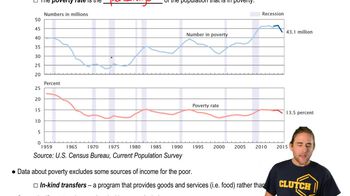
 05:02
05:02