Skip to main content
Microeconomics
My Course
Learn
Exam Prep
AI Tutor
Study Guides
Flashcards
Explore
Try the app
My Course
Learn
Exam Prep
AI Tutor
Study Guides
Flashcards
Explore
Try the app
Back
Public Goods: Demand Curve and Optimal Quantity definitions
You can tap to flip the card.
Private Good
You can tap to flip the card.
👆
Private Good
A product characterized by rivalry and excludability, where consumption by one reduces availability for others.
Track progress
Control buttons has been changed to "navigation" mode.
1/15
Related flashcards
Related practice
Recommended videos
Public Goods: Demand Curve and Optimal Quantity quiz #1
Public Goods: Demand Curve and Optimal Quantity
32 Terms
Public Goods: Demand Curve and Optimal Quantity
8. The Types of Goods
10 problems
Topic
The Free Rider Problem and the Tragedy of the Commons
8. The Types of Goods
10 problems
Topic
8. The Types of Goods
3 topics
15 problems
Chapter
Guided course
08:18
Demand Curve of a Public Good
2182
views
16
rank
Guided course
03:52
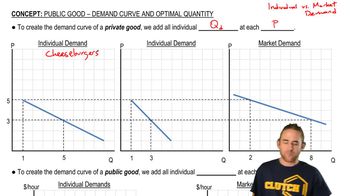
Demand Curve of a Private Good
2560
views
16
rank
Terms in this set (15)
Hide definitions
Private Good
A product characterized by rivalry and excludability, where consumption by one reduces availability for others.
Public Good
A product that is non-rival and non-excludable, allowing simultaneous use by multiple individuals without exclusion.
Market Demand
The total value society places on a good, found by aggregating individual preferences at each relevant point.
Horizontal Addition
A method for constructing demand curves for private goods by summing individual quantities at each price.
Vertical Addition
A method for constructing demand curves for public goods by summing individual prices at each quantity.
Marginal Social Benefit
The combined value all individuals assign to an additional unit of a public good at a specific quantity.
Marginal Social Cost
The expense to society for providing one more unit of a public good, typically represented by the supply curve.
Supply Curve
A graphical representation of the cost to provide various quantities of a good, used to determine optimal provision.
Optimal Quantity
The amount of a public good where the total societal benefit equals the total societal cost.
Non-Rivalry
A property where one person's use of a good does not diminish its availability to others.
Non-Excludability
A property where it is impossible to prevent others from accessing a good once it is provided.
Individual Demand
The value a single consumer places on different quantities of a good, forming the basis for market demand.
Externality
A side effect impacting third parties, not reflected in supply or demand unless specifically accounted for.
Willingness to Pay
The maximum price an individual assigns to a specific quantity of a good, used in constructing demand curves.
Security Guard Example
An illustration of public goods where two businesses share protection, demonstrating vertical addition of demand.
 BackBack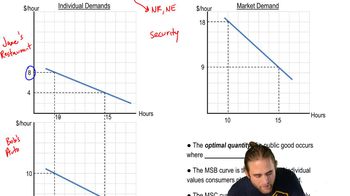
 08:18
08:18