Skip to main content
Microeconomics
My Course
Learn
Exam Prep
AI Tutor
Study Guides
Flashcards
Explore
Try the app
My Course
Learn
Exam Prep
AI Tutor
Study Guides
Flashcards
Explore
Try the app
Back
Repeated Games definitions
You can tap to flip the card.
Repeated Game
You can tap to flip the card.
👆
Repeated Game
Situation where participants face the same strategic interaction multiple times, allowing for evolving strategies and outcomes.
Track progress
Control buttons has been changed to "navigation" mode.
1/15
Related flashcards
Related practice
Recommended videos
Repeated Games quiz
Repeated Games
15 Terms
Repeated Games
14. Oligopoly
10 problems
Topic
Kinked-Demand Theory
14. Oligopoly
10 problems
Topic
14. Oligopoly
6 topics
14 problems
Chapter
Guided course
02:28
Repeated Games
1422
views
9
rank
Terms in this set (15)
Hide definitions
Repeated Game
Situation where participants face the same strategic interaction multiple times, allowing for evolving strategies and outcomes.
One Time Game
Scenario where players interact only once, making decisions without considering future consequences or retaliation.
Interdependence
Condition where each participant's choices affect and are affected by the decisions of others, especially over multiple rounds.
Collusion
Cooperative behavior among participants to achieve mutually beneficial outcomes, often more feasible in ongoing interactions.
Tit for Tat
Strategy involving mirroring the opponent's previous action, fostering cooperation or retaliation based on past behavior.
Trigger Strategy
Approach where cooperation persists until a single act of cheating, after which perpetual retaliation occurs.
Retaliation
Response mechanism in repeated interactions, where negative actions are met with similar negative actions in subsequent rounds.
Collaborative Agreement
Mutual understanding between participants to consistently cooperate, maximizing collective benefits over time.
Cheating
Action where a participant deviates from cooperative behavior to gain individual advantage, often prompting negative responses.
Cooperation
Behavior where participants work together for shared benefit, typically leading to higher collective earnings in repeated settings.
Strategy
Planned approach to decision-making in games, shaped by expectations of others' actions and the possibility of future interactions.
Earnings
Rewards or payoffs received by participants, influenced by their choices and the degree of collaboration in repeated games.
Output Decision
Choice regarding the amount of goods or services produced, often influenced by ongoing strategic considerations.
Mutual Benefit
Outcome where all participants gain more through cooperation than through individualistic or competitive actions.
Long-Term Decision
Choice made with consideration for future interactions and consequences, often leading to sustained cooperation.
 BackBack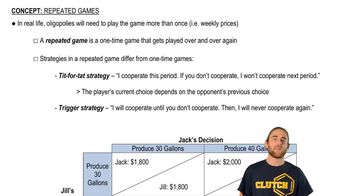
 02:28
02:28