Skip to main content
Microeconomics
My Course
Learn
Exam Prep
AI Tutor
Study Guides
Flashcards
Explore
Try the app
My Course
Learn
Exam Prep
AI Tutor
Study Guides
Flashcards
Explore
Try the app
Back
Repeated Games quiz
You can tap to flip the card.
What is a repeated game in game theory?
You can tap to flip the card.
👆
What is a repeated game in game theory?
A repeated game is a situation where the same game is played multiple times, allowing players to adjust their strategies based on previous outcomes.
Track progress
Control buttons has been changed to "navigation" mode.
1/15
Related flashcards
Related practice
Recommended videos
Repeated Games definitions
Repeated Games
15 Terms
Repeated Games
14. Oligopoly
10 problems
Topic
Kinked-Demand Theory
14. Oligopoly
10 problems
Topic
14. Oligopoly
6 topics
14 problems
Chapter
Guided course
02:28
Repeated Games
1422
views
9
rank
Terms in this set (15)
Hide definitions
What is a repeated game in game theory?
A repeated game is a situation where the same game is played multiple times, allowing players to adjust their strategies based on previous outcomes.
How does a repeated game differ from a one-time game?
In a repeated game, players interact over multiple rounds, whereas in a one-time game, they play only once.
Why are repeated games considered more realistic in real-life scenarios?
Repeated games reflect ongoing decision-making situations, like businesses making output decisions repeatedly rather than just once.
How does interdependence affect players in repeated games?
Interdependence encourages players to consider the long-term consequences of their actions, often leading to more cooperation or collusion.
What is the 'tit for tat' strategy in repeated games?
'Tit for tat' means a player mirrors the opponent's previous action: cooperating if they cooperated, and cheating if they cheated.
How does the 'tit for tat' strategy promote cooperation?
It rewards cooperation and punishes cheating, encouraging both players to keep cooperating to maximize their outcomes.
What is the 'trigger strategy' in repeated games?
The 'trigger strategy' involves cooperating until the opponent cheats once, after which the player will cheat forever.
How does the 'trigger strategy' deter cheating?
It threatens permanent retaliation for a single act of cheating, making cheating less attractive.
Why might Jack and Jill aim for a collaborative agreement in a repeated game?
By collaborating, they can both earn higher payoffs over time compared to consistently cheating.
What happens if one player cheats in a 'tit for tat' strategy?
The other player will cheat in the next round as retaliation.
What happens if one player cheats in a 'trigger strategy'?
The other player will cheat in all future rounds, ending cooperation permanently.
How do repeated games encourage collusion?
Because players interact repeatedly, they can enforce agreements and punish cheating, making collusion more stable.
What is the main goal for players in long-term repeated games?
Players aim to maximize their earnings by maintaining cooperation over time.
How does the possibility of future interactions affect strategy in repeated games?
Knowing they will interact again, players are more likely to cooperate to avoid future punishment.
What is the immediate consequence for cheating in a repeated game with a 'trigger strategy'?
The cheater loses the possibility of future cooperation and faces ongoing retaliation.
 BackBack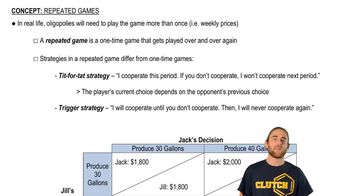
 02:28
02:28