Skip to main content
Microeconomics
My Course
Learn
Exam Prep
AI Tutor
Study Guides
Flashcards
Explore
Try the app
My Course
Learn
Exam Prep
AI Tutor
Study Guides
Flashcards
Explore
Try the app
Back
Short Run Shutdown Decision definitions
You can tap to flip the card.
Short Run
You can tap to flip the card.
👆
Short Run
A period when certain production costs remain unchanged, requiring payment regardless of output.
Track progress
Control buttons has been changed to "navigation" mode.
1/15
Related flashcards
Related practice
Recommended videos
Short Run Shutdown Decision quiz #1
Short Run Shutdown Decision
10 Terms
Short Run Shutdown Decision
11. Perfect Competition
10 problems
Topic
Long Run Entry and Exit Decision
11. Perfect Competition
10 problems
Topic
11. Perfect Competition
11 topics
15 problems
Chapter
Guided course
07:54
Short Run Shutdown Decision (continued)
2755
views
32
rank
Guided course
07:05
Short Run Shutdown Decision on the Graph
2571
views
37
rank
Guided course
03:28
Short Run Shutdown Decision
3513
views
31
rank
Terms in this set (15)
Hide definitions
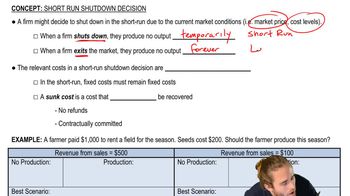
Short Run
A period when certain production costs remain unchanged, requiring payment regardless of output.
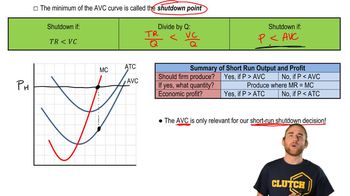
Shutdown Point
The lowest price at which production covers variable costs, below which output ceases temporarily.
Sunk Cost
An unrecoverable expense, such as prepaid rent, that remains regardless of future production choices.
Fixed Cost
A constant expense, like factory rent, paid even when no goods are produced.
Variable Cost
An expense that changes with output, such as seed purchases for each production cycle.
Average Variable Cost
The per-unit expense of variable inputs, crucial for determining whether to continue production.
Average Total Cost
The sum of all expenses per unit, used to assess profitability at different output levels.
Marginal Cost
The extra expense incurred from producing one more unit, guiding optimal output decisions.
Marginal Revenue
The additional income from selling one more unit, equal to market price in perfect competition.
Profit
The surplus of total income over total expenses, indicating financial success at a given output.
Loss
The deficit when total expenses exceed total income, often minimized by strategic production choices.
Perfect Competition
A market structure where firms are price takers, and marginal revenue equals market price.
Exit
A permanent withdrawal from a market, ending all future production and cost obligations.
Demand Curve
A graphical representation of market price and quantity, typically horizontal for individual firms.
Revenue
The total income generated from sales, used to compare against variable and fixed expenses.
 BackBack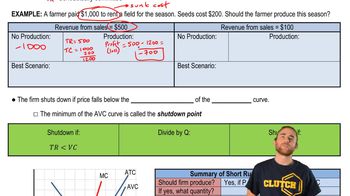
 07:54
07:54