Skip to main content
Microeconomics
My Course
Learn
Exam Prep
AI Tutor
Study Guides
Flashcards
Explore
Try the app
My Course
Learn
Exam Prep
AI Tutor
Study Guides
Flashcards
Explore
Try the app
Back
Solutions to Informational Problems definitions
You can tap to flip the card.
Information Asymmetry
You can tap to flip the card.
👆
Information Asymmetry
A situation where one party in a transaction possesses knowledge that the other party lacks, complicating decision-making.
Track progress
Control buttons has been changed to "navigation" mode.
1/15
Related flashcards
Related practice
Recommended videos
Solutions to Informational Problems quiz
Solutions to Informational Problems
15 Terms
Solutions to Informational Problems
17. Asymmetric Information, Voting, and Public Choice
10 problems
Topic
Median Voter Theorem
17. Asymmetric Information, Voting, and Public Choice
9 problems
Topic
17. Asymmetric Information, Voting, and Public Choice
4 topics
15 problems
Chapter
Guided course
05:57
Solutions to Informational Problems:Screening
521
views
3
rank
Guided course
03:06
Solutions to Informational Problems:Signaling
608
views
Terms in this set (15)
Hide definitions
Information Asymmetry
A situation where one party in a transaction possesses knowledge that the other party lacks, complicating decision-making.
Adverse Selection
A problem arising when individuals with higher risks are more likely to participate in a transaction, often due to hidden information.
Moral Hazard
A challenge where one party may take more risks because they do not bear the full consequences, often after a transaction.
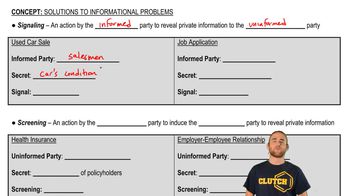
Signaling
An action by the knowledgeable party to reveal private information, reducing uncertainty for the other party.
Screening
A strategy used by the less informed party to prompt the knowledgeable party to disclose hidden information.
Warranty
A guarantee offered to assure product quality, serving as a trust-building mechanism in transactions with hidden information.
Deductible
An out-of-pocket expense required before insurance coverage applies, used to differentiate risk levels among policyholders.
Premium
A regular payment for insurance coverage, often adjusted to reflect the risk profile of the insured party.
Commission
A performance-based payment structure designed to incentivize effort and reveal employee productivity.
Year-End Bonus
An additional payment awarded for strong performance, motivating employees to exert effort and discouraging slacking.
Shirking
A term for avoiding work responsibilities, often addressed through incentive-based compensation.
College Degree
An educational credential used as a signal of intelligence and capability in job applications.
Policyholder
An individual who holds an insurance contract, whose risk profile may be hidden from the insurer.
Fixed Salary
A compensation structure with a set amount regardless of performance, potentially reducing motivation to work harder.
Sales Position
A job role often associated with commission-based pay, used to screen for motivated and productive employees.
 BackBack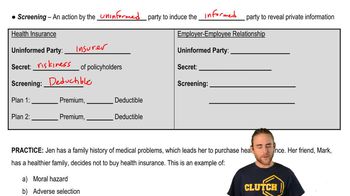
 05:57
05:57