Skip to main content
Microeconomics
My Course
Learn
Exam Prep
AI Tutor
Study Guides
Flashcards
Explore
Try the app
My Course
Learn
Exam Prep
AI Tutor
Study Guides
Flashcards
Explore
Try the app
Back
Subsidies definitions
You can tap to flip the card.
Subsidy
You can tap to flip the card.
👆
Subsidy
Financial support from the government to market participants, increasing traded quantity and causing two distinct prices for buyers and sellers.
Track progress
Control buttons has been changed to "navigation" mode.
1/15
Related flashcards
Related practice
Recommended videos
Subsidies quiz #1
Subsidies
14 Terms
Subsidies
6. Introduction to Taxes and Subsidies
10 problems
Topic
The Laffer Curve
6. Introduction to Taxes and Subsidies
10 problems
Topic
6. Introduction to Taxes and Subsidies
8 topics
12 problems
Chapter
Guided course
09:29
Subsidies
2212
views
10
rank
Terms in this set (15)
Hide definitions
Subsidy
Financial support from the government to market participants, increasing traded quantity and causing two distinct prices for buyers and sellers.
Deadweight Loss
Inefficiency resulting from overtrading beyond equilibrium, where resources could be better allocated elsewhere.
Equilibrium
Point where supply and demand curves intersect, determining the market price and quantity before government intervention.
Elasticity
Measure of responsiveness in supply or demand to price changes, influencing how subsidy benefits are distributed.
Inelastic Demand
Situation where consumers' quantity demanded changes little with price, leading to greater subsidy benefit for buyers.
Elastic Supply
Condition where suppliers' quantity offered changes significantly with price, resulting in smaller subsidy benefit for sellers.
Inelastic Supply
State where suppliers' quantity offered changes minimally with price, granting them a larger share of subsidy benefit.
Elastic Demand
Scenario where consumers' quantity demanded changes greatly with price, causing buyers to receive less subsidy benefit.
Price Received
Amount sellers obtain per unit after subsidy, higher than the price buyers pay due to government contribution.
Price Paid
Amount buyers pay per unit after subsidy, lower than the price sellers receive because of government support.
Supply Curve
Graphical representation of sellers' willingness to offer goods at various prices, shifting rightward with subsidies.
Demand Curve
Graphical depiction of buyers' willingness to purchase goods at different prices, shifting rightward when subsidized.
Benefit Split
Division of subsidy advantage between consumers and producers, determined by relative elasticities of supply and demand.
Overtrading
Market activity exceeding equilibrium quantity due to subsidies, leading to inefficient resource allocation.
Government Contribution
Financial amount provided by authorities, creating a gap between buyer and seller prices in subsidized markets.
 BackBack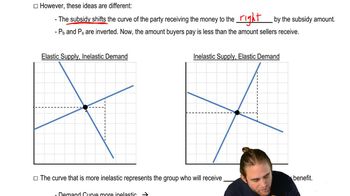
 09:29
09:29