A subsidy is a government payment that lowers the price for buyers and raises the price received by sellers, encouraging more production and consumption than at equilibrium.
What is the effect of a subsidy being placed on the market?
A subsidy increases the quantity traded beyond equilibrium, lowers the price for buyers, raises the price for sellers, and creates deadweight loss due to inefficient resource allocation.
Which observation about subsidies is true?
Subsidies do not fully benefit the receiving party; the benefit is shared between consumers and producers depending on their price elasticities.
What can a country use to counteract another country's subsidies that support an industry?
A country can use countervailing duties or tariffs to offset the effects of foreign subsidies and protect its own industries.
What is a subsidy?
A subsidy is a financial contribution from the government to producers or consumers that lowers market prices and increases traded quantity.
In which scenario will a subsidy increase consumption the most?
A subsidy will increase consumption the most when demand is inelastic, as consumers receive a larger share of the benefit and respond less to price changes.
How are subsidies similar to tariffs?
Subsidies and tariffs both alter market outcomes and can affect international trade, but subsidies encourage overproduction while tariffs restrict imports.
Which group directly benefits from subsidies: exporters, sellers, producers, or importers?
Producers and sellers directly benefit from subsidies, as they receive higher prices for their goods due to government payments.
Which group directly benefits from subsidies: exporters, sellers, producers, or importers?
Producers and sellers are the primary direct beneficiaries of subsidies, receiving increased revenue from government support.
What is a subsidy?
A subsidy is a government payment to producers or consumers that lowers the cost of a good or service, increasing its supply or demand.
A subsidy to producers:
A subsidy to producers increases the price they receive, encourages higher production, and shifts the supply curve to the right.
How does a government subsidy affect the supply curve in a market?
A government subsidy shifts the supply curve to the right by the amount of the subsidy, increasing the quantity supplied at each price.
What is the effect of a subsidy on the prices received by sellers and paid by buyers?
With a subsidy, the price sellers receive is higher than the price buyers pay, as the government covers the difference between these two prices.
How is the benefit of a subsidy distributed between consumers and producers, and what determines this distribution?
The benefit of a subsidy is split between consumers and producers based on the relative elasticities of demand and supply; the more inelastic party receives a larger share of the subsidy benefit.
 Back
Back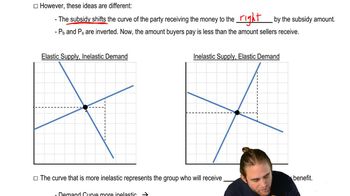
 09:29
09:29