Back

Exercise quiz #1

Control buttons has been changed to "navigation" mode.
1/10
  • Which types of exercise are considered aerobic, and how do they contribute to physical fitness?

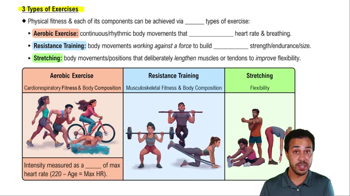
    Aerobic exercises include activities such as walking, running, biking, and swimming. They involve continuous and rhythmic body movements that increase heart rate and breathing, enhancing cardiorespiratory endurance and improving body composition.
  • What is the equation used to estimate your maximum heart rate for aerobic exercise?

    You estimate your maximum heart rate by subtracting your age from 220. This value helps determine appropriate exercise intensity levels.
  • Which type of exercise is primarily responsible for improving musculoskeletal fitness and body composition?

    Resistance training is primarily responsible for improving musculoskeletal fitness and body composition. It includes activities like weight training, body weight exercises, and resistance band exercises.
  • How does stretching contribute to physical fitness and daily life activities?

    Stretching improves flexibility by deliberately lengthening muscles or tendons. Flexibility is critical for all types of exercise and many daily activities.
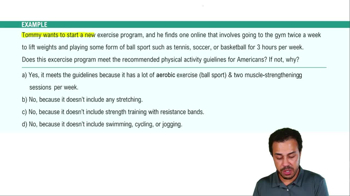
  • What are the recommended weekly guidelines for moderate and vigorous aerobic activity according to the Physical Activity Guidelines for Americans?

    The guidelines recommend at least 150 minutes of moderate aerobic activity or 75 minutes of vigorous aerobic activity per week. Moderate activity raises your heart rate to 50-70% of maximum, while vigorous activity raises it to 70-85%.
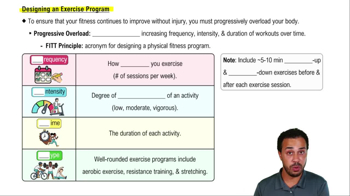
  • Why is progressive overload important when designing an exercise program?

    Progressive overload ensures continuous improvement in fitness by gradually increasing frequency, intensity, and duration of workouts. It helps prevent plateaus and reduces the risk of injury.
  • What does the FITT principle stand for in exercise program design?

    The FITT principle stands for Frequency, Intensity, Time, and Type. It guides the structure of a well-rounded exercise program.
  • Why should a warm-up and cooldown be included in every exercise session?

    A warm-up prepares the mind and body for exertion and reduces injury risk, while a cooldown gradually lowers heart rate and aids recovery. Both should last five to ten minutes.
  • What are some health benefits of regular exercise beyond physical fitness?

    Regular exercise improves mental health, bone density, sleep quality, and lung and immune health. It also reduces the risk of diseases like obesity, heart disease, and type 2 diabetes.
  • Is it better to do some exercise rather than none, even if you do not meet the recommended guidelines?

    Yes, doing some exercise is better than none at all and still provides health benefits. Gradually increasing activity over time is encouraged for greater improvement.