Skip to main content
Nutrition
My Course
Learn
Exam Prep
AI Tutor
Study Guides
Flashcards
Try the app
My Course
Learn
Exam Prep
AI Tutor
Study Guides
Flashcards
Try the app
Back
Fat-Soluble Vitamins definitions
You can tap to flip the card.
Micelle
You can tap to flip the card.
👆
Micelle
Spherical structure formed by lipids in the intestine, enabling absorption of fat-soluble vitamins into enterocytes.
Track progress
Control buttons has been changed to "navigation" mode.
1/15
Related flashcards
Related practice
Recommended videos
Fat-Soluble Vitamins quiz
Fat-Soluble Vitamins
15 Terms
Fat-Soluble Vitamins exam
Fat-Soluble Vitamins
30 Terms
Fat-Soluble Vitamins quiz #1
Fat-Soluble Vitamins
14 Terms
Fat-Soluble Vitamins
7. Vitamins
10 problems
Topic
Water-Soluble Vitamins
7. Vitamins
10 problems
Topic
7. Vitamins
5 topics
15 problems
Chapter
Guided course
01:33
Storage of Fat-Soluble Vitamins
289
views
4
rank
Guided course
03:22
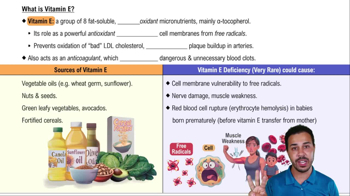
What is Vitamin E?
329
views
2
rank
Guided course
03:45
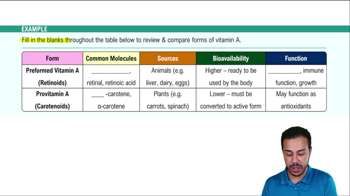
Fat-Soluble Vitamins Example 1
285
views
3
rank
Terms in this set (15)
Hide definitions
Micelle
Spherical structure formed by lipids in the intestine, enabling absorption of fat-soluble vitamins into enterocytes.
Chylomicron
Lipoprotein particle that transports absorbed fat-soluble vitamins from the intestine through the lymphatic system.
Retinoid
Animal-derived compounds, including retinol, that represent preformed, active forms of vitamin A.
Carotenoid
Plant-derived pigments, such as beta-carotene, that serve as provitamin A and must be converted to active forms in the body.
Retinol
Most usable form of vitamin A in the body, essential for vision and cellular functions.
Calcitriol
Active hormone form of vitamin D, produced after conversion in the liver and kidney, crucial for calcium regulation.
Alpha Tocopherol
Main and most active form of vitamin E in the body, functioning as a powerful antioxidant.
Phylloquinone
Primary form of vitamin K found in plants, especially green leafy vegetables, and major dietary source.
Menaquinone
Form of vitamin K found in animal products and synthesized by gut bacteria, contributing to vitamin K status.
Osteocalcin
Bone protein that binds calcium, a process enabled by vitamin K, supporting bone strength.
Antioxidant
Molecule that protects cell membranes from damage by neutralizing free radicals, a key function of vitamin E.
Lacteal
Lymphatic vessel in the intestinal villi that absorbs chylomicrons containing fat-soluble vitamins.
Toxicity
Harmful condition resulting from excessive accumulation of fat-soluble vitamins due to their storage in tissues.
Night Blindness
Vision impairment in low light, often resulting from vitamin A deficiency.
Osteomalacia
Adult bone disorder characterized by soft, weak bones, commonly linked to vitamin D deficiency.
 BackBack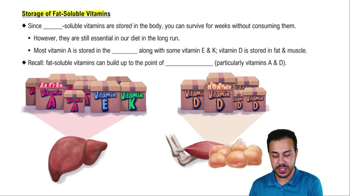
 01:33
01:33